By: The Scribe on Thursday, May 19, 2011
The hills around the Spanish town of Mañaria are home to more than just stone quarries. Paleolithic-era drawings have now been found in the cave of Askondo, a site that is well known to residents living in the area. The cave had been partially destroyed by the activities at a local stone quarry and archaeologists wanted to see whether there were any worthwhile artifacts left in the caves.
 When researchers entered the cave, they were searching for items such as bones, tools and other artifacts as well as stones that may have been used by early residents of the cave. What they found was far more valuable. Even though the cave had been examined many times over the years, the cave art that decorated the walls had never been spotted. Researchers did not even notice the drawings until they were on their way out of the cave.
It was then that the images of handprints and horses were spotted. The drawings have been dated and are believed to have been created approximately 25,000 years ago. The drawings included a red horse with a profile that resembled a duck bill. This was a feature that is fairly common to other European cave art examples.
Other caves in northern Spain have been decorated with Paleolithic cave art. The most famous is likely Altamira. In 1879, scientists discovered that the 270 meter long cave was full of artifacts that ranged in age from 18,500 years ago to 16,500 years ago. The cave was also home to drawings that had been created using ochre, hematite and charcoal. Further variations in color were developed by diluting these three main colors and the end result was a three dimensional image.
Animals tend to be used a lot in Paleolithic cave art. Often, these were animals that were hunted and consumed although not all were. Some of the most common animals that are found in cave art from this era include horses, bison and red deer (also known as hinds). Scientists have theorized that the differences in which animals were most common tended to be more of a regional or artistic difference.
The Basque culture has several legends about the Askondo cave. One legend is that the  cave is the home to a mythological beast known as a lamia. This was a half woman-half duck that attacked a young boy and dragged him into the cave. According to legend, he was not seen from again. Other legends state that the cave was used as a meeting place for witches.
Scientists are examining the Askondo cave more extensively now that the cave paintings have been discovered. They plan to excavate the area in order to tell whether there were signs of people living in the cave at the time that the art was completed. Another plan is to restore the paintings that have sustained the most damage or which have faded more extensively than others. The researchers who are examining the cave say that they are excited due to the fact that it is possible to enter the cave using the original entrance, something which is not possible with many of the other caves where this type of artwork has been discovered.
By: The Scribe on Wednesday, May 18, 2011
If you study the history of ancient Rome, you will likely have heard of the Praetorian Guard. This was an elite group of Roman citizens and others that had been handpicked to act as body guards for the Emperor and other important figures. Members of the Guard also acted as prison guards and carried out various tasks that were considered to be too sensitive to entrust to common soldiers.
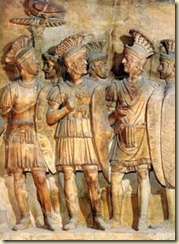 But who were they really? In their earliest days, it is true that they carried out the roles for which they had been chosen. In later days, however, members of the Praetorian Guard became more powerful in their own right and began to act in ways that influenced the political structure of Rome.
Many of the Caesars had a group of personal bodyguards who were chosen for their skill and their loyalty. The Caesars who had such a bodyguard included Julius Caesar, Octavian Augustus and Sertorius. Not all of the personal bodyguards were Romans. Some Caesars chose units of Basque soldiers and others chose to have legions of German troops protecting them. However, it was not until Octavian Augustus took command in 27 BCE that the Guard was formally recruited as a tool that could be used to influence politics as well as the outcome of a battle.
The Guard started out as a relatively small unit. In its earliest days there were only nine cohorts of men. Each cohort held 500 men. Over time, the size of each cohort doubled although only three of the cohorts were on active duty in the capital. There were also cavalry units that were later added to the Guard. These patrolled the palace and other major Roman buildings. At this time, because there did not seem to be much political threat from the Guard most Romans hardly even took notice of their presence.
Things began to change in 23 CE. The prefect at the time, Lucius Aelius Sejanus, was a man with ambition. Due to his urging the Emperor Tiberius decided to build a fort specifically to house the Guard. This structure became known as the Castra Praetoria, which means the fort of the Praetorians. They now were stationed closer to Rome and could now begin to control the political climate in the city much more easily.
The Praetorians were known for their assassination of several Emperors including Caligula (who was killed in 41 CE) and Galba (killed in 69 CE). They also were the force behind Claudius taking the throne after Caligula’s assassination. Emperors knew that without the support of the Praetorian Guard their reign was likely to be a short one.
Later Emperors were careful to limit the size and influence of the Guard. The number of  cohorts was reduced back to nine and one clever emperor, Vespasian, made sure to appoint his son as the Prefect or leader of the Guard. In 284 CE, the Guard was no longer involved in palace life. The emperor at the time, Diocletian, no longer lived in Rome. He replaced the Praetorians with two other units that would act as his personal bodyguards.
The Guard was ultimately disbanded in 312 CE by Constantine the Great. He sent the soldiers to various corners of the empire and even demolished their fortress. Their influence on Rome was finally at an end.
By: The Scribe on Tuesday, May 17, 2011
 When most people look at a guinea pig running around in its cage they may not realize that these cute, furry creatures are actually an important part of traditional South American culture. Today, these small rodents are kept as pets by people around the world but they have actually played an important role in the lives of many of the people living in and around the Andes Mountains.
This small, friendly rodent was domesticated as early as 5000 BCE. Its earliest use was as a food source and they are still kept for this purpose in many areas of South America today. Guinea pigs are easy to care for and feed because they do well on a variety of different foods. A family can use its own food scraps to feed the creatures which are an important source of protein. Tourists who travel to Peru and other countries in the region are often surprised when they are offered these small creatures as a meal.
The guinea pig has also had great religious significance as well. Some civilizations, such as the Moche civilization worshipped the animals and often included them in their artwork. The Moche lived in northern Peru from about100 CE to 800 CE. Statues of guinea pigs that date from 500 BCE to 500 CE have been unearthed in various archaeological digs in Ecuador and Peru.
In many areas of the Andes, Western medicine is still not readily available. They still use the guinea pig in the same traditional healing rituals that have been performed for  thousands of years. Folk doctors, known as curanderos use the rodents as a diagnostic tool. They rub the rodents against the body of the individual that is sick and it is then believed that the rodent can diagnose what the patient’s medical problem is. Black guinea pigs are considered to be particularly useful in obtaining a diagnosis. If the folk doctor wants to know whether the cure has been effective, the guinea pig may be cut open so that the folk doctor can study its entrails. Guinea pigs are also exchanged as gifts and are a part of many different traditions. They are often used in some religious ceremonies and social cultures.
In Western civilizations, the guinea pig has had a much easier life. In many countries they are kept as pets. They first appeared in Europe and quickly became a hit with the upper classes. Some members of the royalty also kept these creatures as pets. Queen Elizabeth I was known to have had guinea pigs as pets. These creatures are friendly and curious and their personalities have made them popular as pets even up to the present day.
There are many modern varieties of domestic guinea pigs. Many of these were actually established between 1200 CE and 1532 CE, when the Spanish conquest took place. Modern varieties include the Abyssinian, which looks like it has cowlicks all over its body, the Peruvian, which has long, straight hair, the Sheltie, which also has long straight hair, and the Texel. The Texel also has long hair but it is curly instead of straight.
By: The Scribe on Monday, May 16, 2011
When archaeologists opened an 18th Dynasty Egyptian tomb in the Valley of the Kings, they made a startling discovery. There, amid furniture, vehicles and other funerary artifacts they discovered vessels full of honey. It had crystallized but was still edible. Honey that was over three thousand years old was not only still in the tomb it was still edible and had not spoiled in any way.
 Honey was used in many different ways by the ancient Egyptians. As well as being used as a natural sweetener for baked goods and other food, it was also a component in the mummification process used by the Egyptians to preserve their dead. Honey was also a part of the religious life of ancient Egypt. It was used as an offering to Min, an Egyptian god of fertility.
Honey was also used in other cultures besides the ancient Egyptians. People have been searching for this natural sweetener for at least ten thousand years. Cave paintings that were discovered in Valencia, Spain showed the process of collecting honey. In the painting, two women are collecting both honey and honeycombs from the nests of wild bees. The painting has been dated to the Mesolithic period.
While many cultures simply looked for honey in the nests of wild bees, the ancient Chinese actually developed beekeeping. It has been mentioned in texts dating from the Spring and Autumn period which lasted from 771 BCE to 453 BCE. In the books, which were written by Fan Li, tips for keeping bees successfully were mentioned. Fan Li, an advisor living in the Chinese state of Yue, stated that the quality of the wooden box used to house the bees was important. He stated that it could affect the quality of the honey that the bees produced.
Honey was used as more than just a sweetening agent or as a food. It was put on wounds by Roman legions as a way to speed up the healing process. Honey contains natural antibacterial properties that can help prevent infection so it was no wonder that it would be used for healing. Even now, many ointments and skin creams contain honey because of its healing properties. Honey was also used to treat skin rashes and burns for the same reason. In Mesoamerica, stingless honey bees have been revered by the Mayan people for thousands of years. They considered the bees to be a sacred animal and cultivated them, a practice which has continued to the present day. 
Honey has also appeared in many different ancient religious texts including the Hebrew Bible, the New Testament and the Qur’an. In Buddhism, honey plays a major role in some religious festivals. One in particular, Madhu Purnima, celebrates the retreat of Buddha into the wilderness as a way of making peace among his various disciples. During this retreat, religious legends state that a monkey brought honey to Buddha so that he could eat. The gift that the monkey brought is one that is common to many pieces of Buddhist art.
Previous page | Next page
 When researchers entered the cave, they were searching for items such as bones, tools and other artifacts as well as stones that may have been used by early residents of the cave. What they found was far more valuable. Even though the cave had been examined many times over the years, the cave art that decorated the walls had never been spotted. Researchers did not even notice the drawings until they were on their way out of the cave.
 cave is the home to a mythological beast known as a lamia. This was a half woman-half duck that attacked a young boy and dragged him into the cave. According to legend, he was not seen from again. Other legends state that the cave was used as a meeting place for witches.


