By: The Scribe on Friday, May 13, 2011
In 2011, there is only one month where the thirteenth day falls on a Friday. This is good news for many individuals who feel that Friday the 13th is an unlucky day when accidents and unfortunate incidents are much more likely to happen. While the phobia of Friday the 13th as a day has only been documented since the late nineteenth century, the reasons why this day may be unlucky actually go back hundreds of years.
Friday’s status as an unlucky day was mentioned in The Canterbury Tales. These were a collection of stories that were written near the end of the fourteenth century. Their author, Geoffrey Chaucer, wrote the work as a collection of poems and stories. They describe the journey of a group of pilgrims as they travel from Southwark to Canterbury. It was believed that beginning a project or starting a journey on a Friday was unwise. It is unknown why this is although one tradition states that Jesus was crucified on a Friday.
For the Knights Templar, Friday the 13th was truly unlucky. The order was both monastic and militant in nature. They were formed to protect the pilgrims who were traveling from Europe to Jerusalem. The Crusades were in full swing during this time and the road that pilgrims would travel was, at times, quite perilous. If the Templars had only stuck to physical protection, they likely would not have had any problems. Unfortunately, the order felt that protecting the money belonging to the pilgrims was also important.
The banking system that the order created helped make the Knights Templar wealthy. They used this money in order to fund the purchase of various holdings throughout Europe. The holdings included wineries, homes, mills and castles. The Templars also lent money to a number of individuals including King Philip IV of France. He had been involved in a war with England that had cost him most of his money. Once that was gone, he had then gone deeply into debt by borrowing from the Templars. Instead of paying the money back, Philip had different ideas.
He accused the Templars of many different crimes. Among the charges were that the order spat on the cross, that the order engaged in homosexual acts, and that they practiced heresy. The charges were backed by Pope Clement V and other Vatican officials. The King sent secret orders to the King’s Men and other Bailiffs. They were to be opened at the same time and acted on immediately.
 On Friday October 13th, 1307 the orders were opened and put into action. Every Knight Templar in France was arrested. Their properties were seized in the name of the king and the knights themselves were tortured until they confessed to the charges that had been brought against them. Their leader, the Templar Grand Master Jacques De Molay was ordered to publicly admit his guilt. Instead of doing so, he publicly recanted his confessions and apologized for the weakness that he had shown.
This enraged King Philip and he had De Molay burned at the stake. While he burned, De Molay cursed both the king and the pope, saying they would die before the year ended. This ultimately came true, which has only added to the evil reputation that this day possesses.
By: The Scribe on Thursday, May 12, 2011
When people envision the life of nuns, they tend to think of women engaging in a life of quiet reflection and prayer. Recent evidence that was discovered by Professor Jennifer Westerfeld shows that at least one group of nuns may have also engaged in creating graffiti as well.
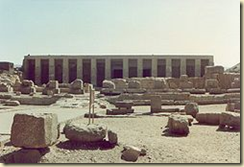 Professor Westerfeld of the University of Louisville has made a discovery on the walls of an ancient Egyptian temple that indicates a group of Coptic nuns visited the site and, when they did, added graffiti to the collection of ancient writings that were already there. The temple, which was located at Abydos, was part of a larger complex made up of courtyards, hypostyle halls, several chapels and a structure that was known as the “Osireion”. It is unknown what this structure was used for. The complex was built approximately 3200 years ago by the Pharaoh Seti I.
This Pharaoh lived from approximately 1294 BCE to 1279 BCE although exact dates are not known. Some archaeologists and historians believed that he reigned for fifteen years although there is only definitive evidence for eleven years of his reign. During the time that he reigned, Seti was able to put an end to social disorder within Egypt and reaffirm the country’s power over Canaan and Syria. He was able to confront the Hittites and was able to defeat them in battle even though he was unable to destroy them totally.
The memorial temple at Abydos, Egypt is one of the major structures that were completed during Seti’s reign. The temple is the location of the Abydos King List, a chronological list showing the cartouches of the dynastic Egyptian pharaohs. This list was extremely important as it has helped archaeologists determine the order in which many of the pharaohs reigned. A total of 76 pharaohs and Egyptian kings make up the list which is divided into three rows containing 38 cartouches each. Not all of the cartouches are the names of kings or Pharaohs. The cartouches on the third row are simply those of Seti’s throne name and praenomen. There are a number of other important structures that are also located at Abydos including a royal necropolis. This is the location where many early pharaohs were entombed and the town rapidly achieved the status of being an important cult site.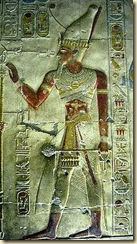
While the complex is 3200 years old, the writing is estimated to be only about 1500 years old. This estimate is supported by the Coptic faith’s history. While the majority of the country converted to the Muslim faith after the conquest of 639-642 CE, a minor part of the population continued to practice a form of Christianity instead. While they still make up a religious minority, the Coptic community in Egypt is still the largest population of Christians in the Middle East.
The graffiti on the complex is important because it proves that there was female monastic activity taking place in Egypt. While it is known that there was monastic activity taking place in the region, very little was known about their activities and information on them was fairly minimal in Egyptian history.
By: The Scribe on Wednesday, May 11, 2011
The first encounter that most people have with lice is when they get a call from their child’s school. They find that their son or daughter is being sent home with a head full of bugs or eggs. The process of combing through hair and treating the scalp will begin. It can be an uncomfortable and embarrassing situation for everyone.
 What they may not realize is that head lice are not the only kind of lice that infest humans. They may also not realize that several discoveries about head lice and body lice have taught us many things about evolutionary history and even the migratory journeys that early humans took part in.
Lice are small, wingless insects that feed off of the blood of their host. They tend to stick to one type of host. For example, the lice that are found on apes, monkeys or other animals would not make their home on a human and vice versa. Lice fall into two main groups: those that chew on their hosts to get blood, and those that suck blood from their hosts. The lice that live on humans are of the sucking rather than the chewing variety.
The lice that live on humans can be further divided into three varieties. The most common is the head louse, which is the plague of school children and their parents in many countries. Body lice live on body hair and in the folds of clothing. They are also quite common and tend to flourish where people are living in crowded conditions. The third type is known as crab lice and these live in the genital region of humans. They are spread from one human to another through sexual contact.
It is believed that lice first split into chewing and sucking varieties between 100 and 145  million years ago. The chewing lice made up the largest group. Sucking lice only have about 500 species including the species that make the lives of human hosts miserable. Further testing showed that head lice found on humans separated from the head lice that are found on chimpanzees about 5.6 million years ago. Using that evidence as well as human DNA evidence, it was possible to prove that human and chimpanzee ancestors also split from one another at the same time.
Head lice are not the only lice that have helped scientists find out more about early humans. For example, scientists who have studied body lice have been able to tell that the invention of clothing only happened about 107,000 years ago. Lice need a place where they can live and breed in between feeding off of the blood of their hosts. Humans do not have enough body hair to support body lice and so body lice evolved to live in clothing. Since they did not exist before about 107,000 years ago, it shows that clothing appeared around the same amount of time.
Although lice continue to plague humans throughout the world they have been useful in helping scientists determine many facts about the lives of ancient humans and how they evolved over time.
By: The Scribe on Tuesday, May 10, 2011
Each year, thousands of religious pilgrims make a journey to Station Island, a small island located near County Donegal in Ireland. On the island is a chapel that had been built over a cave or pit in the ground. They spend three days there, fasting and praying at several sites around the island. In the past, pilgrims would journey to the island as a way to atone for sins or evil deeds that they may have committed but according to religious history, the site was established for a slightly different reason.
According to religious lore, the site (which is known as Saint Patrick’s Purgatory) was shown to Saint Patrick in the fifth century. Christ allegedly revealed the site to Saint Patrick and informed him that it was a literal entrance to hell. It was believed that the site was a cave or pit although some individuals believe that it may actually have been the remnants of a much older structure such as a sweat lodge. According to religious history, the site was referred to as Purgatory by God when the site was being revealed to the saint. It was believed that by showing individuals that Purgatory was real that it would be easier to make the people of Ireland find faith and be converted to the Christian faith.
Saint Patrick lived from 387 CE to 493 CE and was a Briton of Roman descent. He had originally lived in Scotland but was captured by raiders and taken to Ireland when he was approximately sixteen years of age. He lived there as a slave for six years after which he was able to escape and return to Scotland. He was ordained as a bishop after entering the Church and, as a result, was sent to serve in northwest Ireland.
Early Christian converts were full of doubt and, after a while, Saint Patrick began to become discouraged by their constant demands for proof of God. Patrick prayed for God to send him the proof that the people were demanding and, after that, the site on Station Island was revealed to him.
The site originally consisted of a cave but after 1632 pilgrims could no longer access it directly. The site had a narrow entrance which led into a small cave that was divided into two niches. Both were extremely small and only had enough room to kneel and pray in.
 While it was widely viewed as an entrance to Hell, some historians and archaeologists have taken a different view of the site. Originally, a “purgatorium” was not somewhere that punishment took place. Instead, it had a more positive reputation. Individuals would often journey to a purgatorium in order to be cleansed and then healed either physically or spiritually.
Regardless of what the original use for the cave was, it is now a place that is visited by people of all faiths and is now used as a place of prayer, meditation and contemplation. They journey to the island by boat and spend three days with very little food. The pilgrimage involves moving around the island barefoot while a number of prayers and liturgies are recited. This ritual has been taking place for more than 1500 years and shows no sign of slowing down today.
Previous page | Next page

 On Friday October 13th, 1307 the orders were opened and put into action. Every Knight Templar in France was arrested. Their properties were seized in the name of the king and the knights themselves were tortured until they confessed to the charges that had been brought against them. Their leader, the Templar Grand Master Jacques De Molay was ordered to publicly admit his guilt. Instead of doing so, he publicly recanted his confessions and apologized for the weakness that he had shown.


