By: The Scribe on Monday, May 9, 2011
There are many stories and legends surrounding the deaths of early Christian saints. Early saints often came from a variety of ethnic and religious backgrounds. In some cases, their decision to become Christian led to their torture and execution. In other cases, their choice to convert others or (in the case of Saint Valentine) other actions during their lifetime caused them to meet unpleasant ends.
 The early saints were killed in a variety of unpleasant ways. According to legend, two early saints named Chrysanthus and Daria were buried alive. Chrysanthus was the son of an Egyptian patrician. He and his father lived during the reign of Numerian, a Roman Emperor who reigned from 282 to 284 CE. The family was moved to Rome from Alexandria and Chrysanthus’ marriage to a Vestal Virgin named Daria was arranged. Vestal Virgins were priestesses of Vesta. She was a Roman goddess of the hearth. The priestesses kept a sacred fire burning and were also responsible for a number of other rituals as well.
Women were given to the priesthood before they entered puberty and were required to remain celibate and serve the priesthood for thirty years. After their thirty years were up they could then marry but this was quite rare. Many of the women had enjoyed their time of freedom from the social restrictions placed on women at the time and their life of luxury while acting as priestesses. It was because of this that they usually chose to stay on even after their term of service was up.
According to legend, Chrysanthus had remained a virgin after his conversion to Christianity despite his father’s attempts to tempt him with prostitutes and other secular pleasures. After his marriage, things did not change much for Chrysanthus or Daria. Chrysanthus did manage to convert Daria to Christianity but they continued to live in a state of chastity despite their marriage.
Chrysanthys didn’t end his converting ways after his success with Daria. Instead, he continued to work on other Romans, an act that was highly illegal. He was arrested and subjected to torture. Miraculously, his prison turned into a garden. According to legend his wife was sent to live as a prostitute but was able to remain pure due to the intervention of a lioness. When it was seen that this treatment did not break her faith, she was stoned and buried alive with her husband.
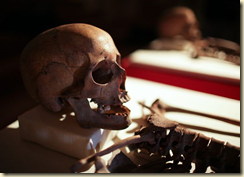 The legend of these two saints grew over time. Their grave was a sand pit near the Roman catacombs. Over time, as pilgrimages to the site increased, a church grew up over their grave. Recently, the remains of the skeletons were analyzed by scientists. They had been sealed off in the Italian cathedral that had been built over their grave.
Tests that were performed on the skeletons support many of the details surrounding Chrysanthus and Daria’s life and their death as well. The female skeleton showed she lived a life of ease and that she belonged to the upper class. The male skeleton was of a younger man and both dated from the period between 80 and 340 CE. While it is impossible to definitively identify the remains as being those of Chrysanthus and Daria, the results which were released in April of 2011 show that many of the details definitely support the information about their life and their death as well.
By: The Scribe on Friday, May 6, 2011
The Vikings were not popular people. When you have the habit of raiding people, burning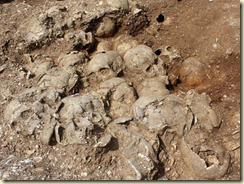 their homes and killing them indiscriminately, your arrival is not usually met with joy and anticipation. A 2009 discovery in southern Britain shows just how some locals chose to treat the Vikings when they appeared on British shores.
Archaeologists have discovered a pit near the town of Weymouth. The remains of 51 skeletons were found in the pit. They had all been decapitated before being placed in the pit and the heads had been stacked to the side. Although the remains had been discovered in 2009, it took several years to determine that they were, in fact, Vikings and not the remains of the ancient Anglo-Saxons who had lived in the area at the time.
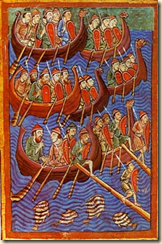
Living in ancient Britain had its challenges. The weather in some areas was somewhat inhospitable. Living near rivers was thought to be a good idea up until the Vikings began moving away from the coast in order to attack more inland settlements. They were able to sail up many of the rivers and were quite willing to walk to others in order to raid them for food and other valuables. Often the sheer numbers of Vikings made them an unbeatable force. It became common knowledge that living anywhere within 20 miles (32 km) of the English coast meant that you were susceptible to Viking raids and attacks.
The remains that were found in the Weymouth pit seem to have met a painful and thoroughly unpleasant end. Many of the skeletons have marks on them that showed they were struck repeatedly with axes and other weapons. Several of the skeletons show defensive wounds and one had several fingers on one hand sliced through. The skeletons also bear marks that showed their heads were hacked off rather than removed cleanly.
 There were many signs that the individuals in the pit were not well-liked. The first is that they had their heads piled to one side. This may have been a form of display that celebrated a victory over the Viking invaders. Another sign was that they were buried on a hilltop. The pit was located near the main road to Weymouth. Victims of the Vikings were usually left where they fell and were often located in villages or on the beaches where the Vikings landed.
The victims were also buried naked which was unusual. This made it difficult for scientists to determine whether the victims were Vikings or were Anglo- Saxons. Archaeologists often use items such as clothes, weapons and other items in order to tell where a victim may have been from. The lack of any clues made it difficult to tell whether the bodies were Vikings or not.
Recently, scientists were able to test the teeth from the skulls found in the pit. This gave them a large amount of information about the individuals buried there. Tests showed that the skulls belonged to individuals who lived in climates that were much cooler than those in ancient Britain. They also showed clues about the diet that sustained the men in the pit which was also different than that of the Anglo-Saxons living in Britain at the time.
By: The Scribe on Thursday, May 5, 2011
Each year on May 5th, many Mexican-Americans (and some Mexicans) gather together to celebrate Cinqo de Mayo. Compared to some celebrations it is a fairly modern one. The celebration celebrates the victory that Mexican troops had during the French occupation of Mexico.
On May 5th, 1862, a force of 8,000 French troops attacked the Mexican army. The odds seemed overwhelmingly in favor of the French. After all, the Mexicans only had about 4,000 troops in their army and the French had proven undefeatable in battle. In the fifty years preceding the battle, no army had managed to defeat the French. Things seemed hopeless.
And yet, they weren’t. Even though the Mexican army was much more poorly equipped, they not only defeated the French they were able to crush them. The battle was known as the Battle of Puebla. In modern times, while the celebration of the Mexican victory is still celebrated by the people of Puebla, Cinqo de Mayo is not celebrated on a massive scale throughout the rest of Mexico. It is, however, being celebrated by many Mexican-Americans who are currently living in the United States. The day has, for them, become a way to celebrate their Mexican heritage.
Cinqo de Mayo is a modern celebration but there are other celebrated traditions that are much older. One perfect example is the Danza de los Voladores or Dance of the Flyers. This is a tradition that has its roots in the time predating the Spanish presence in Mexico. While it is performed in Mexico, the tradition has actually spread throughout much of Mesoamerica.
The practice is a spectacular one. A team of five dancers scales a pole that is 30 meters in height. Four of the participants attach themselves to ropes and the fifth balances on top of the pole. The man on the pole dances and plays a flute, all the while remaining balanced at the top. While he does so, the other four participants (who are known as voladores) launch themselves from the top of the pole. They descend from the top of the pole with only ropes to keep them from falling to their death.
 While the five individuals are traditionally men, women have recently been allowed to take part in the ritual. Women were first trained as voladores starting in 1972 although their participation in the ritual is still quite rare.
The modern version of this ritual was started as a way to appease the gods after a brutal drought that happened approximately 450 years ago. The four voladores represent the elements of earth, water, air and fire. In more ancient versions of the ritual there were taboos and other aspects attached to performing the ritual. In the past, the voladores did not represent the elements. Instead, they would often be dressed in bird costumes instead. There was also much more ritual attached to the harvesting and preparation of the tree that would form the pole used in the ritual.
Different areas of Mexico and Mesoamerica celebrate this practice differently. There are often differences in the shape of the pole
By: The Scribe on Wednesday, May 4, 2011
The actions of Genghis Khan are well known to many people even though he died in 1227 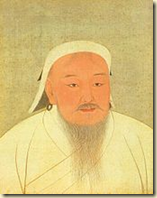 CE. He was known both as a brutal warrior and the builder of the Mongol Empire, an empire that was one of the largest in the ancient world. He was a man of contrasts. On one hand, he slaughtered entire civilizations and exacted brutal revenge on anyone who wronged or betrayed him. On the other hand, he was also known for uniting the Mongolian tribes and turning them into an efficient and deadly army. When he was not laying siege to his enemies, he worked on developing a unified Mongolian language and other elements of Mongolian culture.
Because of the mobile nature of the Mongolian people, there is not a lot of archaeological evidence left that can tell us about Genghis and his exploits. There was, however, one book that included many details about Genghis, his family history, and the activities that led to the creation and spread of the Mongol empire.
The book is titled The Secret History of the Mongols and it was written after the death of Genghis Khan in 1227 CE. The name of the author is unknown. The book was originally written for the Mongol royal family and was not intended to be read by anyone outside this family. It not only provides valuable information about the activities of Genghis it also serves as an excellent example of the Mongolian language. It is the earliest known work that was written in the Mongolian language.
The book is not strictly factual. It also contains a genealogy of the family that is more mythical than factual. There are other areas of the book that are more folklore than fact. It does, however, include valuable information about Genghis’ childhood, his rise to power and defeat of the other tribes, and the campaigns that he led outside of Mongolia. These included the conquest of China, the destruction of the Tangut Empire and the attacks that he led against Baghdad and ancient Russia.
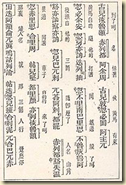 The book has served other purposes than as a source of historical information. It was also used by the Chinese as a way of teaching the spoken and written forms of the Mongolian language. There are no copies of the work that are written solely in Mongolian. Any copy that has been discovered has been a translation that included both Mongolian and Chinese characters.
The book has been translated into several modern languages including modern Mongolian, Russian and English. Translation has been difficult due to the fact that copies of the book became increasingly difficult to find. Translated portions of the book have also appeared in several other historical works.
Genghis Khan slaughtered millions of people during his lifetime, even members of his own family, in a bid to take over the world. Although very little archaeological evidence of the Mongol Empire can be found today, it likely would have pleased Genghis Khan to no end that his reputation and deeds live on, even if only in written form.
Previous page | Next page
 The early saints were killed in a variety of unpleasant ways. According to legend, two early saints named Chrysanthus and Daria were buried alive. Chrysanthus was the son of an Egyptian patrician. He and his father lived during the reign of Numerian, a Roman Emperor who reigned from 282 to 284 CE. The family was moved to Rome from Alexandria and Chrysanthus’ marriage to a Vestal Virgin named Daria was arranged. Vestal Virgins were priestesses of Vesta. She was a Roman goddess of the hearth. The priestesses kept a sacred fire burning and were also responsible for a number of other rituals as well.
 The legend of these two saints grew over time. Their grave was a sand pit near the Roman catacombs. Over time, as pilgrimages to the site increased, a church grew up over their grave. Recently, the remains of the skeletons were analyzed by scientists. They had been sealed off in the Italian cathedral that had been built over their grave.


