By: The Scribe on Tuesday, May 3, 2011
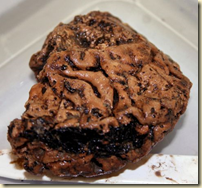 In 2008, archaeologists found a 2,500-year-old brain in York, England. This was a highly unusual find due to the fact that body parts such as brains and other organs will decompose rapidly after death. Unless a deliberate attempt to preserve them is made, internal organs will be completely lost even when other parts of the body such as bones and hair are left behind.
It was believed that the former owner of the brain, a man from the Iron Age, had been the victim of ritual decapitation. Bone fractures and marks on the skull indicate that the body was hanged and then decapitated. It was believed that the cut marks show that after hanging, a knife or other sharpened implement was used to sever the head from the body. While the body was ritually decapitated, it is unknown why the man was hanged in the first place.
The head was thrown into a clay pit. This is what ultimately led to the preservation of the brain. The man’s body, however, has never been located. The thick, wet clay that filled the pit helped to stave off decomposition. The brain did not escape totally unscathed however. It showed signs of dehydration and the loss of water meant that the brain was much smaller than it would have been in real life.
There were several factors that lead to the brain’s preservation. The first is that the clay was very low in oxygen. Oxygen feeds the microbes that dissolve dead tissue and so a low supply of oxygen meant that the work of the microbes was slowed down significantly. The second factor that led to the brain’s preservation was the fact that the temperature in the clay pit was quite cool. When temperatures are fairly low it means that the enzymes which also would have broken down soft tissue could not work as quickly as they would under warmer, more favorable conditions.
Scientists also believe that the brain’s preserved state could have been aided by the fact that the head had been removed from the body. Many of the bacteria that break down a human body actually come from within that body itself. All humans carry bacteria in their gut and these continue to work even after death. This means that a human body tends to decompose from the inside out. Because these bacteria were not present, the body did not break down and the brain may have been decomposed as a result.
Other ancient brains have been discovered but for the most part they are extremely rare 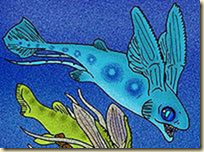 and any ancient brains tended to be fossilized. One prime example is a fossilized brain found in an iniopterygian, which was an ancient ancestor of the modern-day ratfish. The brain that was discovered was about the size of a pea.
Because they still do not understand how the human brain was so well preserved they are continuing to experiment in an attempt to recreate the process. A number of pigs’ heads have been buried around the site which predated the Roman presence in Britain.
By: The Scribe on Monday, May 2, 2011
Some modern snakes can reach lengths of over 30 feet which may seem massive when compared to other animals. The remains of a prehistoric constrictor, which has been named Titanoboa cerrejonensis is more massive by far than any snake that is now living. The name comes from the fact that the remains were found at the Cerrejon Coal Mine which is located in northern Columbia. The discovery was made in 2008.
 The snake lived approximately 60 million years ago. Remains indicate that when full grown, these creatures could achieve lengths of 42 feet (13 meters) or more and could weigh up to 2,500 pounds (1,135 kilograms) making it approximately twice the size of any modern snake and similar in weight to a small car. It had a diameter of approximately three feet. To put the size in more perspective, this meant that the snake was roughly as long as a T-Rex. Modern-day anacondas have been measured at lengths of up to 28 feet and girths of up to 44 inches.
The snake’s remains were found in Columbia. They were discovered by an international team of scientists. The remains are being studied at the University of Florida. It was a bit of a miracle that scientists were able to discover the snake due to the area where it lived. The tropics are a difficult place to find fossils. This is due to the fact that much of the area is covered by a forest and this makes it difficult to find the usual kinds of exposed rocks where fossils are usually located.
The snake killed its prey in the same way that modern constrictors do. It would wrap around any animal that it caught and would squeeze it until the creature suffocated. This would have been a slow death and not a particularly comfortable one.
Titanoboa lived in the time immediately after the dinosaurs became extinct. Other fossils that were found in the area surrounding Titanoboa’s remains showed that the snake likely ate animals such as giant turtles and prehistoric crocodiles. 
The discovery of Titanoboa is important because it gives scientists an idea of what the world was like after the dinosaurs became extinct. Scientists have made educated guesses but the fact that there are few vertebrate fossils available that are known to be from this time period. The fact that the snake was able to reach such a large size is also important because it shows what the climate would have been like during this time period. A snake or other cold blooded creature can only grow to a certain point under certain environmental conditions. A larger snake or other reptile would have meant that the environment was warmer than it is today.
It also shows that the current ecosystem that was in place in the area is very similar to the one that is present today. Remains of the ancestors of modern day reptiles such as snakes, turtles and crocodiles were discovered showing that the current ecosystem was around for at least 65 million years. Because of this, scientists feel that the discovery of Columbian fossils may have been one of the most exciting and valuable discoveries to date.
By: The Scribe on Friday, April 29, 2011
The Ancient Egyptians were known for mummifying animals as well as humans. Animals that were mummified were often beloved pets or were part of votive offerings. Often, they were one of several different sacred animals. Some of the animals that have been found in mummy form include fish, birds of prey, crocodiles, snakes and baboons. It was known that dogs and jackals were also mummified due to their connection to the god Anubis. This deity had the head of a jackal and was associated with the afterlife as well as with mummification.
 Egyptologists found a complex series of catacombs located between ten and twelve meters below the surface of the Saqqara desert approximately one century ago. Saqqara is an area where several important archaeological finds have been discovered. This particular structure was known at the time of discovery as the “Dog Catacomb” and individuals who located the complex found that it was full of the remains of mummified dogs. At the time that it was discovered, it was unknown just how many dogs had been placed in the structure. Now, scientists have returned to the site and have discovered that as many as eight million dogs and other animals were placed in the catacombs. They were placed there at some time between the sixth century BCE and the first century BCE.
The catacomb system is made up of a central corridor with side passages which branch off on either side. In many areas, the piles of mummified remains are up to three feet high. Unlike other animal mummies, which were carefully wrapped and placed in ornamented containers, the dog mummies in the catacombs were often poorly wrapped and were often undecorated. Because they were poorly wrapped, many of them had slowly deteriorated and so were difficult to separate into individual sets of remains.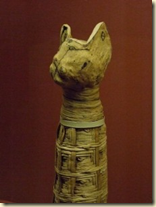
The dogs were not all adults. Many were puppies and may have only been hours old when they were mummified. It is believed that the animals were bred at puppy mills that were located in the city of Memphis, the capital of ancient Egypt. It was believed that the animals could act as an intermediary between humans and Anubis. While the animal that had been mummified was sacrificed in the process, it was the dedication of the mummy that was considered the pious act and not its sacrifice.
When the catacombs were first discovered, a smaller side tunnel was also discovered. It was thought by many that this tunnel was used not to add more mummies to the catacombs but to remove them. Often in the past, animal mummies were sold and ground up as fertilizer. Many were shipped to England and used for such a purpose there.
The dog catacomb is not the only structure of its kind in the area although it is the largest. Several other catacomb structures were found in the same area. Some were dedicated to animals such as baboons, ibises, hawks, cats, cows and bulls.
While the practice of using animal mummies as an offering to various deities was quite common for centuries in Egypt, when the Romans conquered Egypt it slowly died out and eventually ceased sometime after 30 BCE.
By: The Scribe on Thursday, April 28, 2011
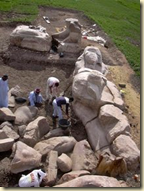 A 42 foot (13 meter) statue of Pharaoh Amenhotep III was recently unearthed in Luxor, Egypt. The city, which is located in the southern part of Egypt is the site of two separate temple complexes. Both the temple complex of Karnak and the temple complex of Luxor are located inside the modern city. The city is also located across the river Nile from other important archeological sites such as the West Bank Necropolis, the Valley of the Kings and the Valley of the Queens. These last two sites are where many ancient Pharaohs and their wives were buried.
Amenhotep III ruled Egypt from 1386 BCE to 1349 BCE. During this time, the country prospered and artistic splendor was allowed to reach its peak. Over 250 statues have been unearthed that depict this pharaoh in addition to large stone scarabs that commemorate everything from his hunting prowess to the creation of an artificial lake that Amenhotep had built for his wife, Queen Tiye. Tiye was only one of several women that Amenhotep married during his lifetime. Many of them were foreign and came from areas such as Babylon and Ammia (which is located in modern Syria). He also married the daughter of several of his allies as well. 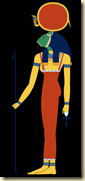
The temple where the statue was found was not located in Luxor itself but was actually located on the West Bank of the Nile. Amenhotep had constructed a large funerary temple which was a normal practice for pharaohs at the time. The statue, which is constructed out of seven blocks of quartzite, was originally positioned in front of the northern entrance to the temple complex. Although the statue was missing a head, it was possible to identify it as being that of Amenhotep III.
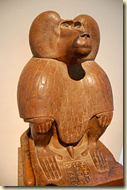
Two other statues were also unearthed at the same time as the Amenhotep statue. One depicted the Egyptian God Thoth. While this deity is often depicted with the head of an ibis (a long-legged wading bird) the statue unearthed at the temple showed Thoth depicted with the head of a baboon. Thoth was associated with magical arts, writing, science and judging of the dead. A second statue measured six feet in height and depicted the goddess Sekhmet. Sekhmet was a warrior goddess who was also associated with healing.
 The temple where these statues were found has recently been the focus of massive excavations. An earlier excavation in 1928 actually unearthed the statue but it was buried again. It is believed that a twin to the Amenhotep statue will be unearthed in future excavations. It is surprising that so many artifacts and statuary can be located in the ruins of the temple due to the fact that the structure was heavily damaged in the past. Both flooding and a massive earthquake in 27 BCE were believed to have contributed to the damage that the temple had sustained.
The temple is one of several that were constructed by pharaohs on the West Bank but of the temples, it is one of the largest and grandest that has been unearthed to date.
Previous page | Next page
 In 2008, archaeologists found a 2,500-year-old brain in York, England. This was a highly unusual find due to the fact that body parts such as brains and other organs will decompose rapidly after death. Unless a deliberate attempt to preserve them is made, internal organs will be completely lost even when other parts of the body such as bones and hair are left behind.
 and any ancient brains tended to be fossilized. One prime example is a fossilized brain found in an iniopterygian, which was an ancient ancestor of the modern-day ratfish. The brain that was discovered was about the size of a pea.


