By: The Scribe on Friday, January 1, 2010
Roman cooking was well known for its excesses. While meals were often quite simple and basic in the early days of the Republic they eventually evolved into very elaborate affairs. The main meal of the day was the cena, which would usually begin at 4pm and often lasted late into the night. When guests were present, the meal could go on for hours. Diners were often entertained by acrobats and other professionals while they ate and meals were often made up of a number of different courses.
There were three main additives that were used in Roman cooking. These included carenum, defrutum and sapa. These ingredients were all made in much the same way. Grape juice or must was boiled down in pots so that water would evaporate. This left a liquid that could be used to sweeten or preserve various types of food and drink. Sapa was created when the liquid had reached one third of its regular volume. When half of the volume had been reduced, the liquid was known as defrutum. When only one third of the liquid remained, it was known as carenum.
The problem with these ingredients is that they were made in lead lined pots. This meant that lead acetate crystals would work their way into the liquid and were therefore consumed along with the food or drink. The lead was actually what caused the mixture to become sweet. When defrutum is made properly it can reach lead levels that are as high as 29,000 ppb. Drinking liquid that has this much lead in it can easily cause acute or chronic lead poisoning.
There were many rules that surrounded the making of defrutum. Pliny the Elder, a well-known Roman historian and author, felt that defrutum needed to be made during the New Moon. He also warned that defrutum should never be made in copper or bronze kettles. He felt that this would cause the defrutum to take on an unpleasant metallic taste.
Cato the Censor, a Roman statesman, felt that the quality of the grape juice would affect the taste of the defrutum. He felt that it was important to use must that was as sweet as possible and that boiling it in a lead pot was most important.
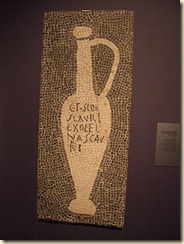 Defrutum was not just added to wine in order to make it sweeter. Romans would add it to meat dishes to make them sweeter. Some ducks and suckling pigs were fed defrutum in order to make their meat sweeter before being cooked. The most popular condiment in Rome, oenogarum, was made up of a mixture of defrutum and garum. Garum is a fermented fish sauce that was a staple of every day cooking in Rome. Defrutum and sapa were both used to preserve fruit such as quince and melon. Roman soldiers were often given food that had been preserved in defrutum as part of their standard rations. Roman women would often use defrutum or sapa as a cosmetic as well.
Because of the high levels of lead that are found in defrutum, it is now believed that this substance, along with the dishes used to eat and drink from, may have actually contributed to illness and the overall decline of the Roman Empire.
By: The Scribe on Wednesday, January 30, 2008

Discovered in a palace from the ancient city of Caesarea, a 1,400-year-old glass mosaic is thought to be the only one of its kind to exist in the current archaeological record.
The city of Caesarea was located on the western coast of the Sea of Galilee, and had successive occupations during the Roman period and the Byzantine era, and it also contains some ruins from the Crusades. The history of the palace that was being excavated, where the mosaic was found, is relatively unknown – the owner of the palace has yet to be discovered, and the time of the building’s original construction remains to be seen. However, judging by the history of the surrounding area, the occupants were likely Christian.
The gleaming glass mosaic found here is unique because of the style of tiling used in its construction: there were two motifs used, both crosses and eight-petal rosettes, while some tiling was done with gold glass and other portions were done using the traditional, multicolored & opaque glass tiles.

The mosaic’s preservation over the centuries was incredible, likely due to the way the panel fell: face down onto the earth, which protected the blue, green, and gold shades from damage and fading.
What the panel was originally used for is unknown – and whether it belonged to a window, or was simply a decorative piece, was unclear from the excavation context. Regardless, the mosaic is a one-of-a-kind discovery, and a clear testament to the high quality of craftsmanship at the time.
Want to read more?

Tomorrow: More Ancient Standard
By: The Scribe on Sunday, January 13, 2008

Sister Maria Celeste, born under the name Virginia Gamba, came into the world on August 16th, 1600. She was the daughter of the now-famous astronomer, mathematician, and philosopher Galileo Galilei and a woman named Marina Gamba – Marina actually bore all three of Galileo’s children, but the two never wed. As a result, Virginia and her sister Livia were considered illegitimate and unmarriable – and so Galileo entered his two daughters into the San Matteo convent of Florence just after Virginia’s 13th birthday.
Galileo wanted his daughters to have a good life and to be cared for, and since they could not marry, life in a convent was the best option at the time. Unfortunately, the girls were considered too young to make the decision to enter a convent for themselves, and Galileo was met with significant resistance from the church authorities. After a time, Galileo was able to obtain special dispensation from the Cardinal Maffeo Barberini – who just so happened to be an admirer of Galileo’s work – and in 1613, his two daughters were placed in the San Matteo convent of Arcetri, Florence.
In 1616, Virginia realized that the life of a nun was truly what she wanted for herself, and proceeded to “take the veil”. She chose the name of Sister Maria Celeste – young women were expected to take a new name, symbolic of their new devotion – which represented both her reverence for the Virgin Mary, and her father’s passion for astronomy.
As Galileo’s scientific books began to stir up controversy among leaders of the Catholic Church, father and daughter began composing letters to each other, an activity which likely sustained Galileo through some of his darkest trials. While very little is known about Maria Celeste’s actual life, about 120 letters have survived – written between 1623 and 1634 – that she wrote to her father while in the convent. Unfortunately, only one side of the story survives – after Maria died, the church authorities burned Galileo’s letters to his daughter, not wishing to retain the writings of someone considered to be a heretic.

The picture of Maria that emerges from these letters is of a caring, loving daughter, who was not only constantly concerned with her father’s well being, but who also seemed to nearly match him in intelligence and wit. She often prepared her father’s manuscripts, a feat which must have been remarkable to accomplish inside the convent – under the rule of the very church that accused her father of heresy. However, Maria saw that Galileo was a devoted man of God whose scientific discoveries clashed in no way with his religious beliefs – yet, in 1633, Galileo was tried and convicted of heresy.
For a time, Maria served as the convent’s apothecary, and was able to send various remedies to her father, now living in Tuscany, for his ailments, and managed to appeal to him on more than one occasion to help the convent’s upkeep – the convent of San Matteo was extremely poor, as the nuns had no means with which to feed themselves or repair the buildings. After notifying her father of various problems, Galileo even took it upon himself to ensure that the convent clock was running properly at all times.
When Galileo was convicted of heresy, he was sentenced to house arrest in Arcetri – which happened to be near enough to the convent that he could see its outer walls and hear the bells each day. Another portion of his sentence had been to recite the seven penitential Psalms once every week for the next three years, which Maria Celeste took upon herself to perform for him – however, it wasn’t long before she contracted dysentery and died on April 2nd, 1634, only four months after her father’s return to Arcetri.
Want to read more?


Tomorrow: More Ancient Standard
By: The Scribe on Saturday, January 12, 2008

Apparently, the ancient Greeks were concerned more concerned about cleanliness and bacteria that they’re given credit for! In ancient Greek mythology, the goddess Hygieia was the daughter of the god Asclepius – the god of medicine and healing – and was associated with preventing sickness and the preservation of good health. Essentially, she was the goddess of cleanliness, health, sanitation… and the moon, oddly enough.
It’s thought that Hygieia might have had her own cult as early as the 7th century BC, but it is more likely that during this period, the goddess Athena was associated with this title – in Plutarch’s writings, he mentions a bronze statue of ‘Athena Hygieia’. However, the early years of the cult were strictly local, and it was only after the ‘Cult of Hygieia’ was recognized by the Oracle of Delphi that the goddess’ worship began to spread.
It probably also helped that there were several critically devastating plagues in Athens in 429 and 427 BC, which was when the cult began to rise in prominence. Another plague at Rome in 293 BC also helped to secure her position there – the people were desperate for help in the face of such a dire situation, so naturally they turned to a goddess who was supposed to be in charge of health.
The largest temples and centers of worship for Hygieia were at Epidaurus, Corinth, Pergamon and Cos – and in these temples were statues of Hygieia to which suppliants would bring offerings. The Greek traveler and geographer Pausanias noted something very interesting about these statues – he noticed that in one Asclepion he visited, the statues of Hygieia were covered in women’s hair and piece of Babylonian clothes! According to inscriptions, the same types of offerings were also made on the Cycladic island of Paros.
Hygieia was a popular subject for artists from the 4th century until late in the Roman period. A Sicyonian artist named Ariphon, during the 4th century, even composed a hymn in celebration of the goddess, and a number of renowned ancient sculptors were responsible for creating statues in her image – including Scopas, Timotheus, and Bryaxis.

In terms of representation, she was often depicted as a young woman feeding a very large snake, which happened to be wrapped around her body. In a number of cases, the snake would be shown drinking out of a jar that she carried in her other hand – which is the origin for one of today’s modern symbols of pharmacy, the Bowl of Hygieia.
Want to read more?


Tomorrow: More Ancient Standard
Previous page | Next page

 Defrutum was not just added to wine in order to make it sweeter. Romans would add it to meat dishes to make them sweeter. Some ducks and suckling pigs were fed defrutum in order to make their meat sweeter before being cooked. The most popular condiment in Rome, oenogarum, was made up of a mixture of defrutum and garum. Garum is a fermented fish sauce that was a staple of every day cooking in Rome. Defrutum and sapa were both used to preserve fruit such as quince and melon. Roman soldiers were often given food that had been preserved in defrutum as part of their standard rations. Roman women would often use defrutum or sapa as a cosmetic as well.