By: The Scribe on Tuesday, January 8, 2008

Samoa may have to re-evaluate its tourism position – after advertising itself as the “cradle of Polynesia” for decades, it turns out that Samoa is actually the middle child. Instead, a small, unassuming fishing village in Tonga has been confirmed as the first Polynesian settlement, established around 2900 years ago.
The site of Nukuleka was identified through pottery shards that were spread around the area, attracting the attention of historians due to their unique appearance. This pottery was carried through the region of Melanesia and into the Pacific by a group of people (whose own origins are still debated) that eventually settled here to become Polynesia’s first inhabitants.
The Lapita people located this first village near the mouth of the Fanga-uta lagoon, which 3000 years ago was a large beach – full of shellfish and small wildlife, such as turtles and birds, which the people ate as their main sustenance. Archaeological investigations on the site uncovered layers upon layers of shellfish in the area, confirming human habitation here was extensive – and that the site was not simply a seasonal encampment.
About a century after their establishment of Nukuleka, the entire group of Tonga islands was settled. It was nearly a thousand years later when the Lapita finally made the decision to move toward eastern Polynesia. It was really only after this migration that the distinctive Polynesian culture was developed, or at least to the extent that it is known today, however the identification of Tonga’s fishing village as the first Polynesian settlement has certainly re-written the history of the ancient Pacific.
Want to read more?


Tomorrow: More Ancient Standard!
By: The Scribe on Monday, January 7, 2008
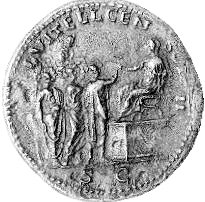 The government in ancient Rome was similar to governments found in many Western countries today – convoluted and with too many levels! But, the Romans liked it that way, as it allowed them to keep track of all the goings-on in the Empire. One of the offices of government was something called a ‘censorship’.
Censors in ancient Rome were responsible for an odd mixture of tasks. Their primary purpose was to take a census of citizens within the Roman Empire every five years: they would write down each citizen’s name, their age, and what amount of property they owned. This was done so that the information could be taken to the quaestors, who would estimate each person’s taxation levels, the Empire’s budget, and the amount of soldiers commanded by Rome.
Although the number of censors and their terms changed throughout the centuries, the tradition of the post held that two censors would serve together for 18 months – one was from the patrician class, while the other was a plebeian.
Once they gained their census information, censors had the charge of determining who among the population was allowed to be counted among certain class levels – for example, who was worthy of senatorial rank as opposed to equestrian, and so forth. This was called the ‘regimen morum’ (public morality), and was an extremely important duty. Other duties of the ‘regimen morum’ were also the verification and stamping with the Imperial Seal any weights or measures, and managing the books of financial institutions.
Apart from their census task, the censors were often responsible for funding and managing public projects. Conquered land was leased out and recorded by censors, while a more important task – or at least in the eyes of the Romans – was for them to choose a farmer who would feed the Capitol’s holy geese for a 5-year term.
Consuls were elected officials by an assembly of Roman citizens called the ‘Comitia centuriata’. They were required to wear a toga bordered with purple, in order to denote their important class, though unlike other elected officials they were not given bodyguards.
As the Roman Empire grew in size, the job of the consulship became rather overwhelming – there were simply too many people for only 2 men to account for, and so the office was eventually abolished. It was replaced with generic officials who would be sent out to count the people on the Emperor’s orders, and they would be counted according to province. For example, the Gospel of Luke discusses how in 8 AD, Caesar Augustus issued a census of the entire Roman Empire.
Want to read more?


Tomorrow: More Ancient Standard!
By: The Scribe on Sunday, January 6, 2008

The origins of Tae Kwon Do lie in the area of Asia known presently as Korea, during the Koguryo Dynasty which ruled between 37 BC and 668 AD. The martial art was developed out of an amalgamation of unarmed combat styles that were being practiced by three rival kingdoms at the time: Koguryo, Baekje, and Silla.
The earliest evidence for Tao Kwon Do is found in wall paintings on warriors’ tombs that date back to around 3 AD. These wall paintings show men engaged in battle with each other, in a type of fighting often referred to as ‘Subakki’. Although different from the kind of Tae Kwon Do practiced today, its origins were found in this ancient fighting style.
Since Koguryo was being threatened by rival kingdoms, a special corps of warriors was formed for its protection. These men were known as the ‘Sonbae’ – meaning “man who never recoils from a fight” – and are thought to have practiced another fighting style called ‘Taekkyon’ , which was a direct predecessor of Tae Kwon Do.
Eventually, the Sonbae’s Taekkyon fighting made its way to the Silla Kingdom, where its own version of the Sonbae – the Hwarang, or “Flower Knights” – took the new style and adapted it for their own use. It was around this time that the “five student commitments” were developed for students of Taekkyon, and which are still taken by Tae Kwon Do students today.

Meanwhile, the third rival kingdom of Baekje – a tribe which had actually split from the Koguryo kingdom years before – was developing their own special warrior corps, called the ‘Soo Sa’. They were employed to defend the kingdom, and learned a fighting style called SooByeokTa, which also built upon Taekkyon fighting and would become a Tae Kwon Do predecessor.
Eventually, the kingdom of Koguryo was able to rise up and conquer its two rivals, which unified Korea under one dynasty. The Koryo Dynasty ruled the area between 918 and 1392 AD, and all men who were a part of the military received martial arts training as part of their regimen. Specific rules and standards of evaluation were thus developed as Taekkyon techniques became standardized, thereby developing what has become known as the first ‘official’ form of Tae Kwon Do.
Since that time, Tae Kwon Do has continued to mature and develop as a martial art, however this is an important part of the art itself – after all, its origins lie in the amalgamation of three fighting styles, centuries ago.
Want to read more?


Tomorrow: Caesar censors
By: The Scribe on Saturday, January 5, 2008

Many pieces of ancient art have little information known about them, other than the context of where they were found and the approximate time period they were from. However, this should not discount their value as incredibly important testaments to human creativity in history. Whether appreciated for their historic value or their artistic merit alone, one would be doing a great disservice to their ancient creators if one was to ignore these tangible objects of the human past.
One of these ancient pieces of art that little is know about is the Venus van Mierlo. This little engraving was found on a piece of sandstone in the Netherlands, at a site called Geldrop-Mierlo in North Brabant province. The image engraved on the stone is of a girl who appears to be dancing – her legs and arms swing out in motion, and she is wearing a low, hip-hugging garment.
Called the ‘Venus of Mierlo’ as a bit of a joke – a testament to the ancient Greek goddess Venus, though the Greeks certainly established their gods thousands of years after this little engraving would have been made – the cultural and religious significance of the piece is completely unknown.
The site where it was found is believed to have been occupied by reindeer hunters, and it is entirely possible that the image of this dancing girl had something to do with their religious notions about the hunt… or, perhaps someone simply was bored and drew a picture on the stone.
Want to read more?


Tomorrow: A brief history of Tae Kwon Do
Previous page | Next page
