By: The Scribe on Sunday, October 28, 2007

In chapters 4 and 5 of Judges in the Hebrew scriptures, a story is told of a woman named Deborah. Deborah lived during pre-monarchic Israel, and held a position as both prophetess and judge – in fact, she was the fourth Judge and the only female to have had this position during the Israelite period.
During this time period, Israel’s judges were regarded more as kings than simply people who tried court cases… and although it is unknown as to how a woman came to be in this position, it is evident by the literature that she was greatly respected and honored by the Israelites. Not only that, but as Judge, she also was the official leader of the army – which means that thousands of men had to follow a woman’s orders in battle, something completely unheard of in this patriarchal society.
Although very little is known about Deborah herself, the text explains that she was married to a man by the name of Lapidoth, and that she sat under a palm tree to give her judgments. She was a poet – which was not an unusual hobby, as there are plenty of examples of Hebrew poetry still remaining today – and her eventual legacy was that she became a ‘mother in Israel’, although whether the title is literal or metaphorical is up for debate.
When Deborah came into power as Judge, the nation of Israel had been suffering at the hands of the Canaanites for the past 20 years. The Canaanites had made sure that the Israelites knew their place in society – taking some as slaves, forcing others to work at backbreaking labor, oppressing their religious beliefs, and even taking their women to marry.

Unlike the Judges before her, Deborah was unwilling to allow these atrocities to continue any further, but there was one problem: the Israelites were at a severe disadvantage. Their army consisted of only 10,000 men, whereas the Canaanites had at least 900 iron chariots and tens of thousands more warriors than Israel. However, since she was a prophetess, Deborah was in a better position than the previous Judges – so, she received instructions from God, telling her to instruct the Israelite general Barak to take his soldiers up to the River Kishon on Mount Tabor.
Deborah’s prophesy was that God planned to send the Canaanite general Sisera and his army up to the same place, but that the Israelites would win the battle. According to the text, Deborah relayed this information to Barak, who agreed to trust her instructions – but only if Deborah would go with him into battle! Instead of trusting the prophesy from God that his army would win, he would only trust this woman – something quite unheard of in ancient Mesopotamia.
In retaliation for his mistrust in God, she prophesied that Barak would not achieve the final victory over the Canaanite general, but this would instead go to a woman. As it turns out, Deborah helped Barak lead the troops into battle, which the Israelites won…with the exception of one small thing: they didn’t manage to kill the Canaanite general Sisera. What happened to Sisera is a tale for another day…
The end of the text on Deborah recalls how she gave thanks to God for the Israelite victory, instead of claiming honor for herself. The book of Judges 5 even includes a poem that she wrote, entitled the ‘Song of Deborah’ , which commemorates the Israelite victory on that day.
Want to read more?


Tomorrow: More Ancient Standard
By: The Scribe on Saturday, October 27, 2007
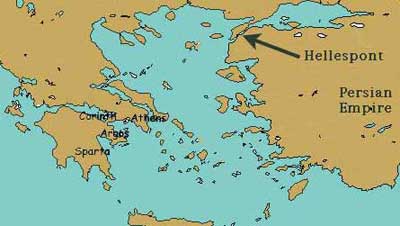
Often referred to by its contemporary European name ‘the Dardanelles’, the Hellespont is actually a long, narrow strait that divides the Balkans from Asia Minor. While that may seem relatively unimportant, the Hellespont also connects the Aegean Sea to the Sea of Marmara, which leads inward toward the Black Sea.
The Hellespont is 61 kilometers long, but only 1.2 to 6 kilometers wide at any given point – which is very, very narrow when it comes to sailing down the strait… not to mention the difficulties and danger that would be involved if a ship needed to be turned around at one of the narrowest spots. In addition, if ships needed to enter the Hellespont from the Black Sea – since that was the only way out – they had to wait on a little island called Tenedos until the winds were favorable enough to allow them to enter the strait. As a result, in ancient times, whoever controlled Tenedos basically controlled the Hellespont – and subsequently all traffic in and out of the Black Sea.
According to Greek legend, the little island of Tenedos was situated near the city of Troy – and after the Greeks left the Trojan horse at the gates of Troy, they went into hiding on Tenedos before conquering the city… and as later mythological events progressed, the strait became named after the mythological Helle, a woman who drowned there during the events of the myth of the Jason and the Golden Fleece.
History’s dealings with the Hellespont were no less dramatic: around 482 BC, King Xerxes I of Persia attempted to have a bridge built across the Hellespont’s width so that his army of “5 million men” (so Herodotus claims) could cross to the other side. Unfortunately for the architects, the first bridge was destroyed by a storm before anyone could cross. Of course, this caused Xerxes to lose his temper as only Xerxes could, and he had the heads of both his bridge architects cut off and ordered the river to be whipped three hundred times – that’s right, he had the water beaten. Thankfully for the next crew, the bridge was a success.
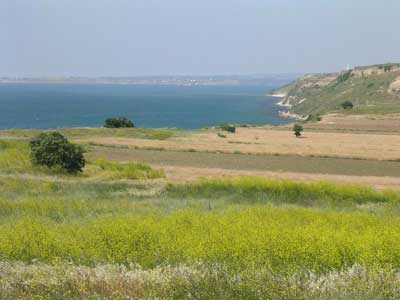
Later on, the Athenians would fight the Spartans at the Hellespont during the final battle of the Peloponnesian War. Unfortunately for the Athenians, the Spartan general Lysander managed to reach the Hellespont first, securing his position before the Athenian navy could arrive. If the navy had made it there first, history would have told a very different tale… but whoever controlled the Hellespont controlled the battle, and at the end of this battle, the Athenian Empire was no more.
In 334 BC, Alexander the Great would cross the Hellespont to invade Persia, an ironic twist on Xerxes’ invasion from the opposite direction just over a century before. Indeed, the Hellespont is full of spilt blood from centuries past – but its history teaches a lesson about the importance of strategic military positioning.
Want to read more?


Tomorrow: The Female Judge
By: The Scribe on Friday, October 26, 2007
Ever wonder how the Egyptians managed to build their large monuments, let alone get them where they needed to be? After all, even if the shapes of statues were carved out once the stone was in place, the stone needed to get to its destination somehow – and there weren’t simply giant limestone stores in the city, either. People had to quarry the stone that to be used, and then transport it to the site where the temple or monument was being built – sometimes hundreds of miles away.
The standing suspicion was that the Egyptians moved their massive stone artifacts from one place to another via waterways – there are plenty of paintings and carvings from Egyptian tombs that show people using large boats and barges to move things like statues and obelisks, and it is not hard to see that both the Luxor Temple and the pyramids at Giza have ancient canals that lead up to their “front door”, as it were.
The only problem was, nearly all the known obelisks from ancient Egypt came from a granite quarry in Aswan – and until now, there was no known canal route to get them from the quarry all the way up the Nile to other cities, except by dragging the monument across the ground on a land journey. That clearly would not have been an ideal situation for these artifacts, considering that some of the larger obelisks can weight upwards of 50 tons. One of the unfinished obelisks in the Aswan quarry is estimated at over 1,100 tons – and was abandoned by the ancient workers only because of the appearance of latent cracks, and not because of its weight.
However, recent discoveries have revealed that there may have been a canal in Aswan after all, hidden from historians for centuries by modern roadwork. This canal would have made transporting obelisks a nearly effortless endeavor, as compared to moving them by land: the canal linked the Aswan quarry with the Nile, which meant that the obelisks could have been moved from the quarry to the Nile, and then sailed down the Nile to their final destination.
The only downside to this method was that the timing had to be perfect – in ancient Egypt, the Nile flooded several times annually, and it was the floodwater that would have filled up the quarry’s canal. So, in order to take advantage of the floodwaters and actually use the canal, workers would have needed to finish their obelisks on time, move the monuments onto rafts and into the canal at a point below the floodwater levels, and wait for the water to come – then the monuments could easily float once the flood came.
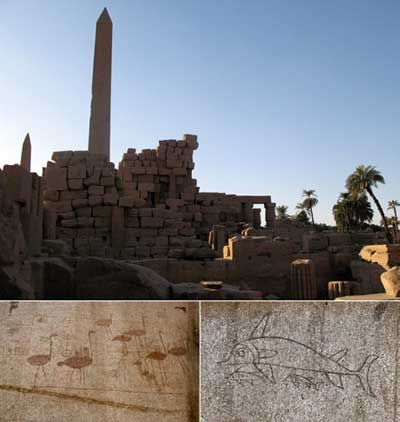
As a side-note, the archaeologists who found the Aswan quarry also discovered graffiti drawings left behind by quarry workers thousands of years ago, as well as grid markings that would have helped with measurements for the obelisks. Some of the graffiti includes images of ostriches and dolphins, but as water levels rise in the area, Egyptologists fear that the graffiti will be lost or washed away forever.
Want to read more?


Tomorrow: What the Hellespont are ‘the Dardanelles’?
By: The Scribe on Thursday, October 25, 2007

Although the popularly held belief is that Columbus discovered America… it seems that he wasn’t actually the first to make it there from across the ocean. That’s right – the chickens beat him to it.
Well, actually both the chickens and the Polynesians arrived at the same time, according to ancient DNA evidence. It turns out that the ancient Polynesians were much better sailors than anyone gave them credit for, and somehow managed to beat Christopher Columbus to the Americas by at least a century, arriving in the early 1400s, if not before.
So, not only did the Polynesians colonize nearly every island in the South Pacific – and there’s plenty of evidence for their existence on these islands – but they apparently figured that journeys of several thousand miles weren’t enough. They wanted to sail even further, which brought them to: South America.
Ancient chicken bones found along the coast of Chile were DNA analyzed and compared with the DNA of other chickens found at archaeological sites across the Polynesian islands. The results? The chickens’ genetic stock was Polynesian and not European… and since chickens have a bit of problem when it comes to sailing across the open Pacific on their own, they must have arrived on the ships of Polynesian sailors.
The chicken bones dated to sometime between 1320-1410 AD, which fits with the time when Polynesians probably would have been expected to reach the American continent, although until now, there was no evidence that they actually did so. It is likely that they traveled here from Easter Island, and made their way across the ocean to Chile.
The Mapuche people living in Chile today, coincidently, have quite a number of Polynesian words in their language, and some of their tools are very similar to Polynesian items. While this may be a direct link between these people and the ancient sailor, there is not enough evidence to be %100 certain.
At the very least, there can be no doubt that Polynesian chickens – and humans – discovered America well before Christopher Columbus ever knew of its existence.
Want to read more?


Tomorrow: Sailing Obelisks
Previous page | Next page
