By: The Scribe on Monday, October 15, 2007

Jack Rackham – otherwise known as Calico Jack because of his preference for calico garments – was one of the more famous English pirates of the 18th century. However, he wasn’t necessarily remembered for all the things he did himself, but instead gained notoriety for who he was associated with: Calico Jack was responsible for employing two of the world’s most famous and notorious female pirates in his own crew, Anne Bonny and Mary Read.
Before he was captain of his own ship, Rackham was quartermaster on the ship of English pirate Charles Vane. Vane was infamous for his disrespect of the pirate code and for his cruelty, and so when the opportunity to dispose of him as captain presented itself – his crew took it. After failing to engage a French warship they encountered in the Caribbean, the crew mutinied in disgust at his cowardice, leaving him adrift on a small sloop in the middle of the ocean. Rackham was voted in as the new captain almost immediately, and proceeded to plunder several vessels that very day.
It was during a stop at a port’s tavern that Rackham met and began to court a young woman named Anne Bonny, who readily accepted his affections. Unfortunately for the two of them, Anne was already married, and her husband refused to let her go… and instead of sticking around to see the results of James Bonny’s court order against Rackham and Anne, the two of them eloped. However, women were still considered bad luck aboard a ship at this point – not to mention that they were in danger of abuse from the other men – and so Anne was disguised as a man in order to ensure the crew would take no notice of her.
While raiding a merchant vessel in the West Indies, Calico Jack came across a sailor on the vessel who had escaped slaughter like the rest of the crew. He gave the man an option: to either be run through with a cutlass, or join his crew. Naturally, the latter option was preferable, and the man joined the crew on Rackham’s ship.

Shortly thereafter, Rackham noticed that Anne and the new crew member were spending a good deal of time together. With his jealousy ignited, Rackham confronted the young man… who admitted that he was actually a woman in disguise. Realizing the benefit for Anne in keeping another woman around, Mary Read was allowed to remain on the ship, and it wasn’t long before Rackham revealed to his crew that there were, in fact, two women aboard… news which, oddly enough, was received rather well.
Rackham and his crew continued to attack and plunder ships with the women’s help, but in October 1720, a British governor learned of the pirate captain’s theft of an anchored ship in the Nassau harbor. Two large ships were sent after him, and they managed to catch up with Calico Jack at a moment of extremely poor timing – Rackham’s crew was in the hold, recovering from a rather severe round of drinking. They took cover below deck, but were eventually taken prisoner.
Rackham and his crew were taken to Jamaica, which was under British occupation at the time, and sentenced to death by hanging on November 16, 1720. After his hanging, his body was placed inside an iron cage and hung from a gibbet on a small island that could be seen from Jamaica’s Port Royal.
But what of Bonny and Read? After witnessing Rackham’s death, a report was given that she said she “was sorry to see him there, but if he had fought like a man, he need not have been hanged like a dog.” The fate of the women was somewhat different…
Want to read more?


Tomorrow: The story of Anne Bonny
By: The Scribe on Sunday, October 14, 2007

Once thought to be merely an ancient legend, it turns out that several thousand years ago, the Chinese were using sticky rice to cement their walls. Indeed, this glutinous ‘rice porridge’ was the best kind of mortar additive available, surviving until today in the remnants of plaster on ancient Chinese bricks.
It was during a round of maintenance work on the ancient wall of Xi’an that workers found that the plaster on many bricks was extremely difficult to remove – and since the task was much more difficult than it should have been, the substance was tested. Infrared analysis then revealed that the mortar had a molecule structure nearly identical to that of glutinous or “sticky” rice.
In fact, the use of rice as mortar may be the real reason that many ancient Chinese structures are still standing! The wall of Xi’an was built in the early years of the Ming Dynasty that spanned from 1368-1644 AD, and still remains standing at approximately 12 meters high.
While the claim that construction workers used sticky rice to build the Great Wall of China had previously been discounted as a myth, it turns out that there may have been truth to the legend after all.
Think about it: workers wouldn’t have to stop for lunch, they could just snack while they were working…!
Want to read more?


Tomorrow: More Ancient Standard!
By: The Scribe on Saturday, October 13, 2007

During the pre-Meiji era in ancient Japan, the term “Kugyo” was used to refer to a group of the most powerful men of influence in the court of the Emperor. The group typically contained only three or four men at one time, and each came from a background of extensive experience that had brought them to this ‘pinnacle’ of his entire life’s work. They were also hereditary courtiers, and each held one of four specific offices.
The Sadaijin was the “Minister of the Left”, and as the Senior Minister of the State, he oversaw all the branches of the state and had the Udaijin as deputy. Within the State Department – or, Daijo-kan – his position was second in power and influence to the Great Minister of the Realm. For centuries, the position was most commonly held by a member of the Fujiwara family, in order to justify the influence the family held in Japan.
The Udaijin was “Minister of the Right”, and he helped the Sadaijin to oversee all the branches of the Daijo-kan.
The Naidaijin was the “Inner Minister” or “Minister of the Center”, with the rank and role of this position varying over time. He was essentially responsible for internal affairs and making sure they were kept in order.
The Dainagon position was created in order to assist the Sadaijin and the Udaijin with their affairs, although by the 17th century, the position had been modified to give primary assistance to the Nadaiji. This was done in order to ensure that there was another person ready to replace the main court officials, should something happen to one of them.
Although the Kugyo had a large amount of power and responsibility during the early pre-Meiji eras, they gradually lost power as the Fujiwara family came to dominate Japanese politics in the 10th and 11th centuries. By the 12th century, the group was nearly powerless – and it certainly didn’t help that the warrior clan Minamoto seized control of the country through the aristocratic courts.
Regardless, the Kugyo continued to function as a figurehead group inside the palace walls for centuries to follow.
Want to read more?


Tomorrow: More Ancient Standard
By: The Scribe on Friday, October 12, 2007
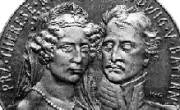 On October 12th, 1810, the Crown Prince Ludwig of Bavaria married Princess Therese of Saxony-Hildburghausen – and to commemorate the event, the citizens of Munich were invited to the front gates of the city to celebrate and join in the festivities. Food, drink, and horse races marked the day as one to be remembered… literally! The wedding celebration was such an enormous success – and the people enjoyed themselves so much – that the decision was made to repeat the festival every year, eventually giving rise to the Oktoberfest tradition.
The second year of Oktoberfest, in 1811, marked the addition of an Agricultural Show, which was created to boost awareness and publicity of Bavarian agriculture. There was little else to do at the early Oktoberfests – other than watch the horse races, look at agriculture, and drink – but in 1818, two swings and a carousel were added! Small beer stands were also becoming more prevalent, meaning that more people could afford to join in the festivities at a lower cost.
The first Oktoberfest parade took place in 1835, with the intention of honoring the original wedding that inspired the festival. It took awhile to catch on, however, as the concept of an annual parade didn’t really sink in until 1850. It was also in 1850 that the Statue of Bavaria was commissioned to watch over the festivities.
Over the next several decades, Oktoberfest would continue almost uninterrupted, but in 1854 and 1873, the festival was cancelled due to cholera outbreaks. There were also no festivities in 1866 while Bavaria fought in the Austro-Prussian War, and again in 1870 during the Franco-Prussian War. However, by 1880, there were over 400 tents and booths at the Munich festival – and in 1881, Oktoberfest attendees could purchase bratwursts at small food stands!
It was in 1892 that beer was first served in glass mugs, and by 1896, the small beer stands were so numerous that they had to be replaced by beer tents! Breweries began to sponsor the event, and large halls were set up and decorated by more affluent members of the local community. In 1910, Oktoberfest celebrated its 100th anniversary… and will mark its 200th anniversary in just a few years!

Want to read more?


Tomorrow: The Powerful Kugyo of Japan
Previous page | Next page
