By: The Scribe on Thursday, October 11, 2007
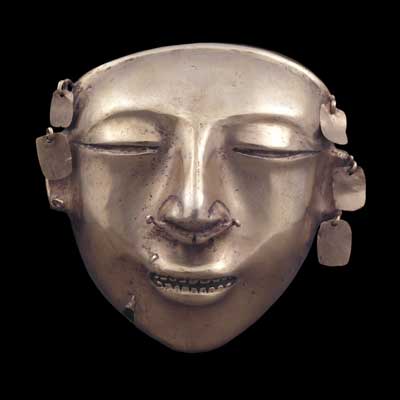
If there is one highly notable thing about ancient South America, it’s that the continent was home to many, many indigenous cultures – all of which developed independently of each other, becoming specialists in various, distinct areas. One of these lesser known cultures, but certainly not any less talented, was the Quimbaya civilization of Colombia.
The Quimbaya were noted for their incredible talent in goldworking, which was revealed through their highly technical accuracy and exquisitely detailed designs. Their gold pieces also have a very distinct hue and shine, which comes from the inclusion of 30% copper with the gold, creating an alloy known as “tumbaga”.
The favored subjects of Quimbaya gold art pieces were men and women in sitting positions, almost always with closed eyes and rather placid expressions. Gold funerary masks were also created with the same general expression on the face, and these were often placed inside the sarcophagus of a deceased individual – gold was believed to have been a sacred thing, and very useful for achieving safe passage into the afterlife.
The Quimbaya generally lived around the Cauca River in Colombia, and although it is believed that they probably settled there sometime in the first century AD, the culture did not really reach its height until the 4th to 7th centuries. Then during the 10th century, the Quimbaya disappeared as mysteriously as they had appeared… leaving behind purely archaeological evidence of a civilization with advanced cultural development, a structured chiefdom, and groups of people dedicated to specialized trades, such as pottery, goldwork, trade relations, the military, and religious duties.
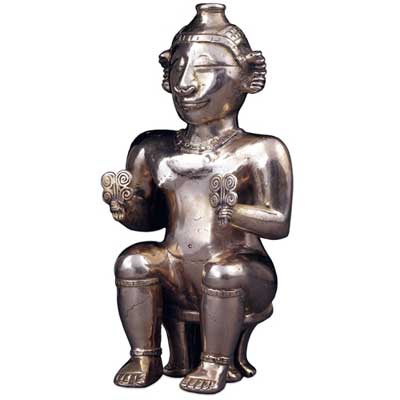
Beyond this, little else is known – except for one thing: the Quimbaya were drug addicts. Many of their gold figurines have flasks around the neck, or are even flasks themselves, and held a substance called lime. Lime was chewed together with coca leaves in order to release their “active stimulant” – and anyone who knows even a bit of plant biology will probably recall that coca leaf is the raw material used to manufacture a more commonly known drug: cocaine.
Of course, the Quimbaya believed that this stimulant helped them to bring about a state of clear and contemplative thinking, and may have been an important part of the culture’s religious beliefs – the drug was probably used during fertility rituals, in order to commune with ancestral spirits and ensure the continued regeneration of essential plant and animal life in their land. Why would this be the case? There are actually several present-day people groups in Colombia, such as the Kogi, who utilize coca for a very similar purpose!
Want to read more?


Tomorrow: More Ancient Goodness!
By: The Scribe on Wednesday, October 10, 2007

At the site of Tell Brak in Syria, several mass graves from approximately 5,800 years ago have revealed the remains of over 60 young adults… and the density of additional bones inside the graves suggest that the final body count will reach well into the hundreds.
During the time when these people died, the city of Brak was expanding at a rapid rate, and with population growth came the development of better technology and more lucrative trade. Naturally, external enemies would have seen Brak as a very appealing target for attack and control. Also, since Brak was one of the earliest urban centers to develop in the ancient Near East, it is entirely possible that there were several warring internal factions – what might be called “growing pains” brought about by urbanization, since it was an entirely new process at this time.
Most of the bodies found represent individuals from their late teens to mid-30s, which would have been the healthiest portion of the population – and it appeared as though the bodies were partially decomposed at the time of burial. Many of the skeleton’s hands and feet had also been removed, and their limb bones piled up inside the mass graves. Most of the bodies’ skulls were also detached.
Since no weapons or goods were found with the bodies, it looks as though whoever killed these people went through the battle area afterward and removed any valuable items – all that remains is a large quantity of broken pottery, over 200 cattle skeletons, and plenty of sheep and goat bones. This evidence suggests that someone had a feast at the time of burial, but whether it was the victors of the massacre or a group of people mourning or commemorating the battle, is as of yet unknown.
Regardless of whether the slaughter happened as a result of internal or external conflict, the battle at Brak was obviously a very serious blow to the local population, and is a clear example of the type of issues people in the ancient Near East faced as urbanization developed.
Want to read more?


Tomorrow: Colombian Quimbaya
By: The Scribe on Tuesday, October 9, 2007

Before Alexander the Great made his way to the Nile delta and established his own city in 331 B.C., the northern coast of Egypt was home to a city called Rhakotis. Although Rhakotis is mentioned in several ancient history texts, until recently, the actual existence of the city had never been proven – but now, it seems as though Alexander the Great was more of a renovator than a city builder.
Teams of underwater archaeologists were diving in Alexandria’s bay, searching for Greek and Roman ruins, when they stumbled across some signs of building construction that appeared to be 700 years older than Alexander the Great’s arrival in the area. In order to substantiate the evidence, researchers took soil sample cores from the Mediterranean ocean’s floor – some as large as 20 feet long – and dated them with radiocarbon technology.
The cores revealed that the ocean floor held lead and human waste that was over 3,000 years old, confirming that there was indeed human habitation along these shores long before Alexander ever arrived; the cores also contained pieces of stone building materials that would have come from southern and central Egypt. By looking at historical documents that have survived the centuries, all evidence pointed to the true, historic existence of the Egyptian city of Rhakotis.
The lead from the cores was dated to around 1000 to 800 BC, with some portions suspected to date back even further to Egypt’s Old Kingdom – if this is true, it means that people were living here over 2000 years before Alexander arrived! Lead was a very important substance for humans in the ancient world, and in large cities, it was not unusual for lead to be used in everything from fishing, building, ship construction, and plumbing, to more artistic activities like glass making.
Want to read more?


Tomorrow: Urban conflict in Ancient Syria
By: The Scribe on Monday, October 8, 2007
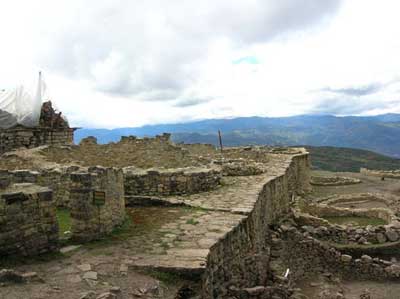
As previously discussed here on The Ancient Standard, most of what the world knows about the Chachapoyas culture of ancient Peru comes from their burials and several pieces of monumental architecture, such as the fortress of Kuelap. While there are still many unanswered questions about this civilization and their eventual fall under Spanish occupation, a recent discovery may shed a little more light on the lives of the Andean Cloud Warriors.
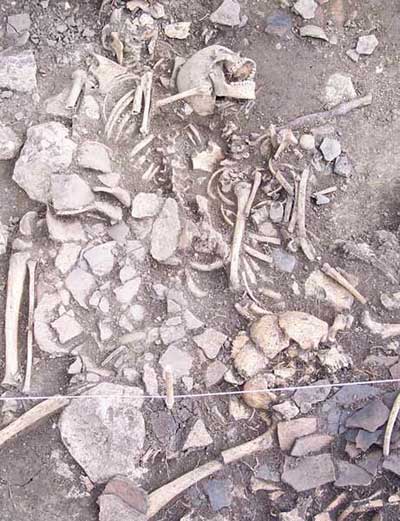
Inside the fortress of Kuelap, excavation teams recently uncovered approximately 80 bodies: men, women, children, young and old – the skeletons seem to represent the culture’s entire demographic. While that may not seem unusual at first, the fact is that the bodies were discovered inside of the fortress and were unburied. Instead, the bodies were dispersed or in small groups, giving every indication of these people still being in the place where they were when they died.
The fact that these people don’t seem to have been touched or moved after their deaths is highly troubling, especially considering that the Chachapoyas were known for their elaborate burials – after all, that is where most of the information about these people comes from, since they did not develop their own writing system with which to record their history.
Why so many people died here, and why they were not buried, is a question with highly speculative answers. Perhaps there was a plague, and other tribe members were afraid to touch the cursed bodies? Perhaps the Spanish invaded in a surprise attack, slaughtering everyone in the fort before they could escape? Was there an internal conflict? Either way, the entire episode must have happened very quickly – many of the bodies had artifacts next to them that were typical of daily use, meaning that they did not have time to pack anything up or even drop the dishes or tools that they were carrying!
Some specialists in South American archaeology have identified pieces of pottery at Kuelap as Incan, which means that the rapid deaths of these people must have happened during the time of the culture’s Incan captivity. It is well known that the Chachapoyas were fierce fighters, continuing to rebel against the Inca even as their culture was suppressed and their people dispersed.
One possibility is that the Inca sent their own warriors to the site to kill a group of Chachapoyas who refused to submit to their authority, or perhaps the event occurred near the end of the Spanish suppression of the Inca, around the time when the Spanish turned on their Chachapoyan allies and forced them to convert to the Spanish way of life.
Certainly, closer forensic examination of the skeletons will reveal more information about how they died – whether by violent trauma or through an epidemic – and through this, hopefully a greater understanding will arise of this period in ancient history.
Want to read more?


Tomorrow: More Ancient Standard
Previous page | Next page
