By: The Scribe on Wednesday, June 19, 2013
 The next time you’re craving a chocolate fix, remember—it’s only human! Humans have been yearning for the bittersweet treat for hundreds (maybe thousands?) of years… and a recent discovery at a settlement in Utah may have set the “chocolate in America” date back by 200 years!
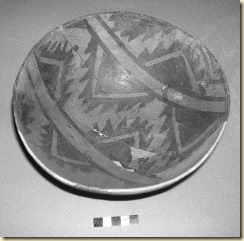
The site, which dates back to the 8th century and is known as Alkali Ridge, contains the oldest known traces of chocolate found in the USA. Dr. Dorothy Washburn, a researcher from the Museum of Archaeology and Anthropology at the University of Pennsylvania, studied residue from 18 pottery vessels taken from the site in the 1930s, and found that 13 of the vessels contained traces of cacao (more commonly known as “cocoa”).
The jars, bowls, and pitchers contained evidence of theobromine, which is a chemical compound found in chocolate (yep, that’s the one that’s safe for humans, toxic for dogs!). The only other North American plant that’s known to contain the substance is a toxic holly plan, occasionally used by Midwestern cultures to induce “ritual vomiting.”
Critics who cite that it might have been the holly in the jars are mistaken, according to Washburn. “The only conclusion can be that it’s cacao,” she says, because cacao was known to have been a staple of life in Mesoamerica—and the holly only grows in the Southeastern USA.
And as for how cacao made its way to the Southwest in Utah? Well, that’s another mystery. It’s possible that it arrived through trade routes… or, even more likely, through the movement of people from one place to another.
 During this period, it’s possible that people living in Mesoamerica were making their way up to the American Southwest, using trade routes to migrate and find new places to live. Today, it’s not unusual for people to do that same thing—immigrate from Central America to the Southwestern United States. Maybe they just arrived earlier than we’d thought!
The pottery that the traces of cacao were found in is another clue as to what the plant was doing in Utah—the pottery isn’t at all like what was the typical local pottery of the time, indicating that different people were living alongside the Pueblo culture of the area and continuing to create their own traditional pottery and pot designs.
During the 8th century, Mesoamerica was in the midst of an upheaval—by the year 900 A.D., many Mayan city states had collapsed, and people were on the move… and Washburn believes some of them ended up at this little site in Utah.
(More research on this find has been published in the Journal of Archaeological Science.)
By: The Scribe on Monday, June 17, 2013
The next time you’re stuck in gridlock on the highway, spending hours in traffic to get to your destination, remember… the ancient Persians had it better than you. Despite the enormity of the Persian Empire in 5th-century BC, the Persian Royal Road was built for speed and efficiency. And it actually worked!
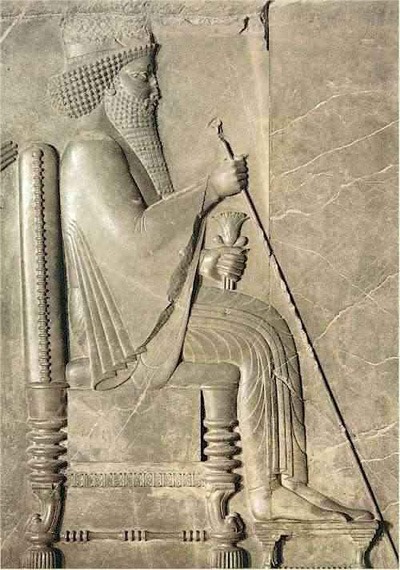
The Persian Royal Road was a reconstruction and rebuilding of an existing ancient highway by Darius I (also known as “Darius the Great”), king of the Achaemenid Empire from 522 BC to 486 BC. The intent behind constructing the road was so that rapid communication between corners of the vast empire—from Susa to Sardis—could be facilitated as effectively as possible.
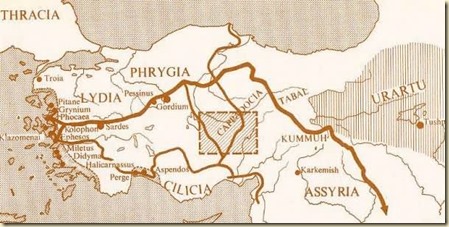
Moving along the road, couriers on horseback were able to travel 2699 kilometers in just seven days (1677 miles)! Even the famous Greek historian Herodotus was impressed by this feat, writing that “there is nothing in the world that travels faster than these Persian couriers.”
Through archaeological research, historical records, and Herodotus’ writings, most of the ancient highway’s route has been reconstructed, and it’s thought that there would have been many outposts—also known as caravanserai—along the route, where travelers could rest and refresh during their journey.
And the couriers definitely needed places to rest, because the road didn’t always follow the easiest route between cities! Rather, there were sections of road that Darius I reconstructed which likely had been built by Assyrian kings, since it heads through the heart of their empire—and like today’s road construction projects, it’s often easier to just fix a road than try to build a brand new one.
 That said, Darius I’s reconstruction efforts were so good that the road continued to be in use until the Roman period, whereupon the Romans made some improvements of their own. The Romans used improved paving technology—ie. a hard-packed gravel surface held within stone cubing—and new posting stations to ensure travelers had access to fresh horses, particularly when messengers had to travel with an urgent message from one side of the empire to the other.
The most famous feature about the Persian Royal Road actually comes from Herodotus’ writings… a quotation about the Persian messengers and their travel speed along the reconstructed highway:
“Neither snow nor rain nor heat nor gloom of night stays these couriers from the swift completion of their appointed rounds.”
And you thought he was talking about your mailman! Come on… 2699 kilometers in seven days? Next time your mail arrives late, tell that mailman he has no excuse!
By: The Scribe on Friday, June 14, 2013
Hey, you… yeah, you over there on the couch! What was it you said this morning? You were “too tired” to exercise? Or you “didn’t have enough time”? Or “it hurts”?
 Come on. Seriously. You have no excuses anymore, and you know why? Apparently, paleontologists have discovered the remains of an ancient fossil fish that shows shocking signs of—get this—ripped abdominal muscles.
Look, if a fish from 380 million years ago could do it? You can too.
Nobody wants to get shown up by a fish.
But seriously, it was previously thought that only land animals developed abdominal muscles, but Gogo fish fossils found in the Kimberly region of Western Australia are causing scientists to question what they previously knew about muscle development in ancient creatures.
Did the abs found in the ancient fish serve the same function as they did in land mammals? It’s hard to say. It’s also strange because for fish, “their main mode of propulsion is of course to flap their tails to left and right so all the muscles are sitting on the side of the body",” says Gavin Young (of Australian National University’s Research School of Earth Sciences).
A study on these ripped fish was published in Science, which mapped the musculature of the ancient fish for the very first time—and this was only possible because researchers discovered that some of the specimens still had preserved elements of soft tissue!
The fossil fish are considered Placoderms, which have often been compared with sharks, but not even sharks have abs. These fish had armored plating along their bodies, and are the earliest-known jawed vertebrates.
An associate professor at Curtin University explains why abs on ancient fish is so ludicrous—and remarkable: “Abdominal muscles were thought to be an invention of animals that first walked on land but this discovery shows that these muscles appeared much earlier in our evolutionary history.”
Despite the bizarre nature of abs on fish, any fitness buff will tell you—it’s probably because they didn’t eat carbs.
By: The Scribe on Wednesday, June 12, 2013
Deep in the Canadian North… in a frigid town called Timmins, where even polar bears fear to tread… there’s been–
Editor: Wait, wait. Hold up. What do you mean, “deep in the Canadian North?” You mean Timmins, Ontario, home of Canadian country pop sensation Shania Twain?
 Umm… yes.
Editor: That’s what I thought. Please continue.
Right. Ahem.
So, as we were saying, in a small town in northeastern Ontario where it’s not quite as cold as some people would like to believe (you have to go much further north for that), a team from the University of Toronto made a rather incredible discovery.
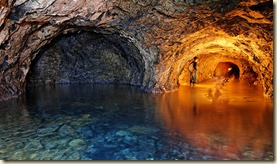
Inside boreholes in the Timmins Mine, about 2.4 kilometers below ground level, the team collected samples of ancient water that is estimated to be between 1.1 and 2.6 billion years old.
Yes, that’s as old as the rocks in the mine! When the surrounding rocks formed, that depth of 2.4 kilometers down? Would have been ocean floor. That means folks who walk around in the Timmins Mine in those boreholes are walking on 2.6 billion-year-old seafloor.
The team who collected the samples found that the water contained rich amounts of dissolved gases, such as methane and hydrogen. These gases can provide energy for microbes that tend to be found around hydrothermal deep-ocean vents.
Barbara Sherwood Lollard, an Earth Scientist and co-author of the water study, says that a find like this “shows us that there’s been very little mixing between this water and the surface water; what we want to do … is see if we can narrow that [age range] down.”
By measuring the concentrations of other rare gases in the water—neon, helium, argon, and xenon—the team was able to make its estimation of the water’s age, ie. how long it had been trapped underground, and whether it had interacted with any other water or if it remained isolated all that time.
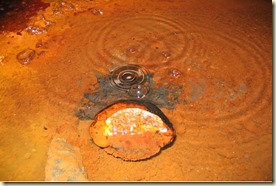 The next step to this find is in testing the water for microbes—yes, living microbes that might be billions of years old! Some ancient microbes can survive for that long without access to sunlight, and can reveal new information about the development of life on Earth.
This ancient water provides the necessary evidence to prove that pockets of water can exist in isolation under the Earth’s crust for billions of years—and may have implications for the possibility of life on other planets!
Geochemist Steven Shirey has weighed in with his thoughts on the study, saying that “if you think that you can have microbial life throughout the entire crust of the Earth, then all of a sudden it becomes very possible that life could live on other planets under the right condition.”
Considering that there’s known to be warm rock under the cold surface of Mars, it’s possible that water may still exist… and perhaps some ancient Martian microbes?
(Editor: Hmm… The Ancient Standard: Mars Edition… that sounds pretty good…!)
Previous page | Next page
 The next time you’re craving a chocolate fix, remember—it’s only human! Humans have been yearning for the bittersweet treat for hundreds (maybe thousands?) of years… and a recent discovery at a settlement in Utah may have set the “chocolate in America” date back by 200 years!
 During this period, it’s possible that people living in Mesoamerica were making their way up to the American Southwest, using trade routes to migrate and find new places to live. Today, it’s not unusual for people to do that same thing—immigrate from Central America to the Southwestern United States. Maybe they just arrived earlier than we’d thought!