By: The Scribe on Saturday, September 1, 2007
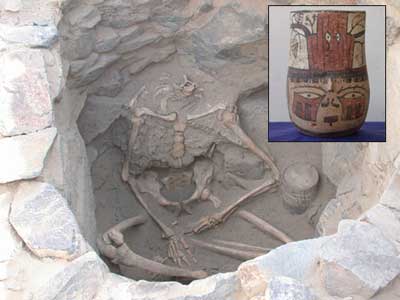
Known best for their production of the Nazca lines in the Peruvian desert, it appears that the Nazca culture did more than just create sand art – they also created some fantastic pieces of pottery… ceramic heads, to be precise. In fact, the Nazca were rather fond of worshiping their ancestors through human sacrifice: they would decapitate their victims, modify the skull to be a ‘trophy’ head, and display this as a symbol of their worship.
The only problem is, no one is quite sure whether the victims in these sacrificial rituals were actually enemies from war or rival tribes, or if they were simply local people who offered themselves up for the sake of the group. Fortunately in 2004, an archaeologist from Texas State University discovered a Nazca burial that may help to shed some light on the dilemma.
The burial contained a rare, headless skeleton inside of a tomb-like structure, sitting cross-legged and with a ceramic ‘head-jar’ by his left elbow. By looking at the age of the skeleton and the condition of the burial – as well as taking into account the ceramic jar, painted with dual inverted faces – it has since been determined that the victim was killed and buried in a ritual of ancestral worship. At the time of death, the victim was a 20-25 year old male, and there are still visible cut marks along the neckline – meaning that not only was this person decapitated, but the cuts were made on fresh bone…ergo, it would have taken quite the effort to cut off this person’s head!
The site of the burial was at a place called La Tiza, where only several other Nazca head jars have been found before. Although they’ve typically been considered a part of high-status burial ritual, the function of the replacement head jars is also still under debate. Judging by where this man was buried and the style of death, his sacrifice was likely meant to honor the ancestors buried at this Nazca cemetery – in effect, he was killed in order to appease the ancestral spirits and ensure the fruitful continuation of the community.
Since the ceramic jar was painted with two images of a human face – which, when looked at directly, one is right side up and the other upside-down – the jar was probably meant to serve as a ‘substitute’ for the victim’s decapitated head! Based on other Nazca images in the area, it is thought that the Nazca believed a person needed a head in order to enter into the afterlife – so naturally, a replacement head would have been necessary, especially for a sacrificial victim! Of course, this generous treatment leads one to think that perhaps the ritually killed individual was a local community member after all…or, there is always an alternative possibility that the man was killed in a battle and had his body retrieved by family members who simply chose to bury him here – however, that doesn’t make quite as interesting a story.
Want to read more?


Tomorrow: More Ancient Standard!
By: The Scribe on Friday, August 31, 2007
 During the Neolithic period around 5000 years ago, some tasty new creatures arrived on the shores of Great Britain… namely, sheep, pigs, and cattle. Up until this time, the people of England had mainly subsisted on fish and other marine species for the majority of their diet – however, with the introduction of these domesticated animal species, along with some new domesticated plants like wheat, the palates of the ancient Brits took a bit of a turn.
Historians have been aware for quite some time that the ancient Britons stopped eating fish at some point along the way, but whether it was a gradual or rapid process has been up for debate. By 4000 BC, there is evidence that domesticated plants and animals were in the area, but did the people adopt these new food sources easily, or did they continue munching on fish sticks when a T-bone steak was available just a few steps away?
Studies of animal and human bones left around some Neolithic archaeological sites in Great Britain have revealed that, in fact, the ancient Brits heartily embraced their new culinary options. Believe it or not, the maxim “you are what you eat” actually rings true to a degree – human bone and tissue is made up of elements from the various foods ingested during a person’s lifetime. When that person dies, the bones retain what could be described as a ‘record’ of what someone has eaten over the course of their lifetime.
The bones examined from the ancient British sites showed that these Neolithic people – who had previously relied on marine species and fish to fill their diets – almost completely abandoned eating fish and seafood once the new domesticated plants and animals arrived. Apparently, the farming lifestyle seemed more attractive than sitting around and fishing.

Farming plants and animals may have been preferred over eating fish due to several factors: the potential for a steadier, more reliable food source; climate change; or cultural pressure. According to the evidence, the fishing lifestyle that had been in place for hundreds of thousands of years was just given up – abandoned – over the course of one generation!
One thing is certain: it is only after this complete shift to domesticated plants and animals that larger populations and more complex societies began to appear in ancient Britain… and rather rapidly, as well. While historians are quick to point out that humans could produce and obtain more food through these domesticated species than they could gather through marine trapping and fishing, there is another explanation that no one seems to have bothered considering… maybe hamburgers just taste better!
Want to read more?


Tomorrow: Prosthetic…head?!
By: The Scribe on Thursday, August 30, 2007
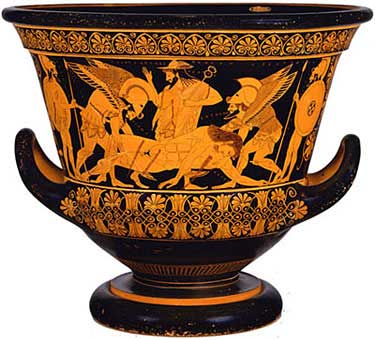
The two-handled ancient Greek bowl shown here was created around the year 515 BC, and is considered to be one of the finest existing Greek vases today. Referred to fondly as the ‘Euphronios krater’, the bowl was made out of terracotta in the calyx-krater style, and would have been used to mix wine with water. It can hold about 45 liters of liquid, and was decorated with the red-figure pottery style.
The bowl represents a collaborative effort between two men who were known as some of the best artists to have lived in the 6th century BC in Athens. The potter’s name was Euxitheos, and the painter was Euphronios – looking at the vessel, it is not difficult to see that the shape of the bowl and the figural composition work together almost perfectly to create a vivid scene that conforms precisely to the proportions of the vessel.
Quite unusually, both the painter and the potter signed their names to this bowl! Usually it was only the painter who signed his name, however on this piece, both men who worked on it gave themselves credit for the work – which seems to suggest that they both believed that it was one of their best pieces ever created.
There are two scenes on the Euphronios krater . The first side depicts an episode from the Trojan War: the death of Sarpedon, son of Zeus. On either side of the dying man, personifications of Sleep and Death lean over to pick up Sarpedon and carry him off to his homeland for burial. Behind the youth is Hermes, directing the way for the body to be carried. The level of detail in this scene is so intense and graphic that not only did Euphronios choose to illustrate the scene while Sarpedon is still bleeding profusely from his wounds, but you can also see extremely delicate details such as his eyelashes and toenail cuticles!

On the opposite side, Athenian youths arm themselves for war or training – the scene seems rather generic, however the ideal of young, fit, trained men ready for battle was an important part of Athenian culture at the time the vessel was crafted.
Along with the painters’ signatures, there is an inscription on one side that reads: “Leagros is handsome.” Incredibly, this inscription was what allowed historians to date the bowl accurately to around 520-510 BC, because it was at this time that textual evidence explains that Leagros was considered by many people to be the handsomest man in Greece!
Want to read more?


Tomorrow: More Ancient Standard
By: The Scribe on Wednesday, August 29, 2007
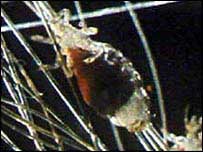 While Roman soldiers stationed at the northern front of the empire and Hadrian’s Wall did battle to stave off attacks from “barbarian” tribes, they were also doing battle with a smaller, less obvious foe: those devious creatures now commonly known as head lice.
An excavation outside of Carlisle Castle in Cumbia revealed an ancient soldier’s haircomb, excellently preserved and including a fully intact, 3mm long louse. Based on stratigraphy, the comb and louse are about 2,000 years old!
The Roman fort of Luguvalium, an ancient site located near Carlisle Castle, was founded around 72-73 AD to help defend the Roman Empire’s border along Hadrian’s Wall. Since the Roman ground layers where the comb and louse were found is largely waterlogged, it’s quite the feat that both these items survived until present day. Thousands of additional artifacts were also found at the site, but the louse was among the most intriguing – according to site archaeologist Carol Allen, the louse is one of the largest and more complete examples of the creature ever found in the Roman world.
Along with pieces of wood and textile that normally don’t survive in this environment, it is hoped that the louse and assorted items will help to shed some light on what it was like to live inside a Roman fort in the 1st century AD. Unfortunately for the people who once lived there, at first glance it now appears as though the situation was less than hygenically ideal.
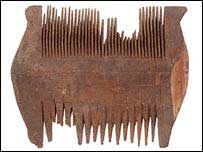

For the record, it is already known that lice have been around for hundreds of thousands of years, though complete ancient specimens such as the one found inside the Roman comb are rare, if not nonexistent in most parts of the world. However, it’s worth noting that the treatment of head lice has not changed much since ancient times – take a look at the ancient Egyptian louse comb and the modern louse comb pictured above.
Resilient, those lice.
Want to read more?


Tomorrow: Euphronios Krater
Previous page | Next page
