By: The Scribe on Tuesday, August 28, 2007
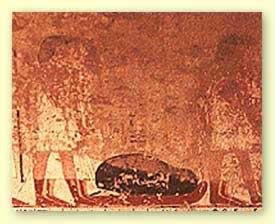 Appearing most often in burial scenes, the tekenu was a mysterious figure that shows up on tomb paintings and funerary texts – though who he is or why he appears remains unknown. The tekenu seems to be the figure or shape of a man, and is shrouded in either a bag, animal hides, or a sack that is placed on its own sledge in the midst of a funeral procession.
One theory suggests that this shrouded figure was actually a sack of spare body parts left over from the mummification process, since it was pulled alongside the canopic jars and sarcophagus containing the mummified corpse. If this is the case, the images of the tekenu where he has a face must mean that there was a mask or a false head placed at the “neck” of the sack, causing the tekenu to appear as if it was a real person. It may have also simply served as an image of the deceased individual himself.
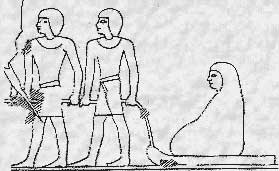 Other suggestions have been made that try to link the tekenu to possible human sacrifice in ancient Egyptian history. One oft-cited piece of evidence for this comes from an inscription found on the Tomb of Rekhmire, which reads: “Causing to come to the god Re as a resting tekenu to calm the lake of Khepri.” The thought is that this may be a remnant from a time when humans were killed and thrown into a lake to appease certain gods – however, there is no additional evidence for this, nor for the tekenu ever having been a human sacrifice.
In fact, in the Tomb of Mentuherkhepshef (try saying that five times fast) from the 18th dynasty, there is a man lying on a sledge, just like the tekenu, but unshrouded. In another scene from the Tomb of Rekhmire, the tekenu is removed from his sledge and placed on a chair inside a tomb, placed with its head poking out of the bag. In the scene following this, the same man is sitting upright on the chair, wearing a shroud wrap but also clearly supposed to be alive.
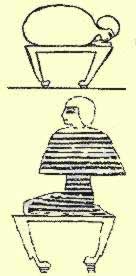
Egyptologist Greg Reeder has interpreted this series of images as finally revealing who and what the tekenu was. Reeder’s theory is that this was a Sem priest who initially went into a trance at the beginning of the funeral procession, playing the role of a shaman who “visited the deceased in the otherworld… as the tekenu he is transported to the tomb wrapped in a shroud to help facilitate his ‘death’ so that he can be transported to the other world”.*
The priest’s visit to the spirit world was supposed to give him powers that subsequently enabled him to perform the traditional ‘Opening of the Mouth’ ceremony that was held during all burial rituals. Essentially, the role of tekenu was then to go through a state of metamorphosis from the tekenu to Sem – a transition from death to life.
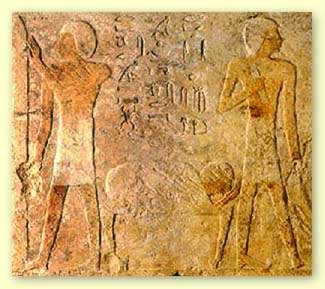
Of course, there are currently no other texts that might support this interpretation… but this is the most plausible theory thus far.
*Greg Reeder, “A Rite of Passage: The Enigmatic Tekenu in Ancient Egyptian Funerary Ritual”, KMT: A Modern Journal of Ancient Egypt 5 (1994).
Want to read more?


Tomorrow: More great Ancient Standard
By: The Scribe on Monday, August 27, 2007
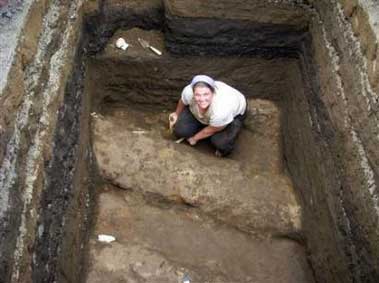
About 1,400 years ago, the Loma Caldera volcano near the ancient village of Ceren decided it was time to erupt. As a result, the little Mayan village of Ceren was buried under ten feet of ash – and was probably abandoned when the people realized that their mountain was in rather shaky condition.
Fortunately for today’s archaeologists, the ash layer perfectly preserved what was underneath – including a field of a nutritious crop called manioc. Also referred to as yucca or cassava, there had been no previous evidence for Mayan cultivation of manioc… however, this find may finally provide clues as to how the Mayan civilization was able to prosper and feed such a large population.
It has been long known that the Mayans grew and ate corn and beans, but what they grew to supplement this diet has, for the most part, been speculation based on artistic depictions and clues from various Mayan codex scrolls. This calorie-rich tuber would certainly have played a prominent role in ensuring the people ate a healthy and substantial diet – and helped to support their enormous cities such as Copan and Tikal.
Along with finding this ancient but freshly planted field of manioc, ground penetrating radar helped to locate the remains of homes, religious buildings, workshops, storehouses, kitchens, and even a community sauna at Ceren!

Other Central and South American cultures would also later come to rely on manioc as a large component of their diet, including the Pre-Columbia civilization of the Moche.
Want to read more?


Tomorrow: More Ancienty Goodness!
By: The Scribe on Sunday, August 26, 2007
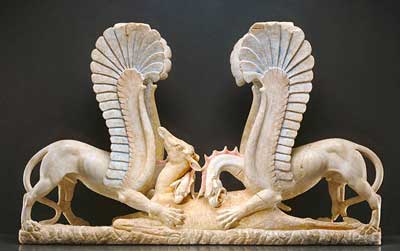
In this marble table support piece, two griffins with upraised wings tear violently into the flesh of a fallen doe – a symbol of civilization’s oppression of barbarism, or perhaps more candidly, the oppression of any group of people who did not conform to the ‘proper’ Greek way of life. Mythological creatures that blended together elements of lions, snakes, and eagles were quite popular in Greek art around 300 BC, and images of these creatures were often used as a metaphor for the struggle and confrontation between life and death.
Aside from some very minor additions, this piece of sculpture was carved from one, single block of marble – but it did not always appear the way it now stands. In fact, the entire sculpture was once covered in richly colored paint, some of which still remains in trace amounts. There are small spots of blue still visible on the griffins’ wings, bright red on their manes, traces of brown on the deer’s body, and some remnants of green on the base.
Adding an element of the macabre to an image that already exudes violence, small traces of red paint that represent blood remain around the mouths of the griffins and inside of the claw scratches on the deer’s body. If it were not for the cut marks along the top and inner surfaces of the wings, it would not be obvious that the 3-foot-high sculpture served as the base for a table!
Although very few examples of furniture of this elaborate magnitude have survived, the unfortunate truth is that the exact provenance of this piece is unknown – it is only known to have come from someplace in Southern Italy, called “Magna Gracia” in ancient times – and it was probably looted many years ago from a site near the Italian town of Foggia. While it is currently on display at the Getty Villa, it is under negotiations to return to Italy in the near future.
Want to read more?

Tomorrow: Mmmm Manioc…Ancient Manioc!
By: The Scribe on Saturday, August 25, 2007
 In the summer of 2007, a student in western Finland working on an archaeological dig came across an interesting find – it was a lump of birch bark tar from about 6,000 years ago! Based upon the time period that it was from, as well as the appearance of the lump of hardened substance, it didn’t take long to deduce that it was, in fact, a piece of ancient chewing gum.
It is known that during the Neolithic period, humans used birch bark tar as an antiseptic to treat mouth sores like gum infections, or even for household tasks such as repairing a pot. Birch bark tar in particular contains something called “phenols”, which are antiseptic compounds that help to treat infections naturally.
Chewing sugar-free gum – whether it is modern gum or ancient birch bark tar – also helps to stimulate the production of saliva in the mouth, which works as a preventative method against tooth decay.
In the case of this ancient piece of birch bark tar, there are tooth marks remaining on the piece of gum that confirm it was in someone’s mouth thousands of years ago! Interestingly enough, an amber ring and a slate arrowhead were also found near the ancient treat.
Even if they weren’t necessarily aware of the gum’s medicinal properties, it appears that humans of all millennia have enjoyed popping a tasty, chewable treat into their mouths… perhaps they even had their own troubles with scraping used gum off of sandals.
Want to read more?


Tomorrow: Eagle vs. Shark? Forget it…Griffins vs. Deer!
Previous page | Next page
