By: The Scribe on Friday, August 24, 2007
 After Cyrus II came of age, Harpagus convinced the young man that the Medes were ready and willing to revolt against their now despotic king, Astyages. Cyrus then organized a federation consisting of 10 Persian tribes, and attacked his father… though for some reason – or as Herodotus claims, “blinded by divine reason” – Astyages appointed Harpagus as the leader of his army. Naturally, Harpagus was not eager to fight for the man who had killed his son, and instead marched on the Median capital with Cyrus, both Persian and Median armies in tow, and took Astyages captive.
Although the details of Herodotus’ tale are more likely based around fairy tale than fact, the end of the story has been confirmed by another ancient document called the Chronicle of Nabonidus. The document explains that in the 6th year of the reign of King Nabonidus of Babylon,
“king Astyages called up his troops and marched against Cyrus,
king of Ansan [Persia], in order to meet him in battle. The
army of Astyages revolted against him and in fetters they
delivered him to Cyrus. Cyrus marched agast the country
Ecbatana; the royal residence he seized; silver, gold, other
valuables of the country Ecbatana he took as booty and brought
to Ansan.”

At the very least – whether Harpagus was involved with the army’s defection or not – the details in the Chronicle of Nabonidus imply that after three years of fighting, king Astyages’ troops mutinied and handed him over to Cyrus. Unfortunately for Cyrus, Astyages’ allies did not take the capture of the allied king so well – shortly after the capture, King Croesus of Lydia attacked Cyrus II to avenge Astyages. With Harpagus at his side – for which there are confirmed records – Cyrus defeated Croesus’ advances and ended up overthrowing Lydia as well.
What happened to Astyages after his capture remains unknown. Although the ancient sources agree that he was treated with mercy and leniency not typically given to captive kings, the details of how this occurred differ. While Herodotus claims that the king was left imprisoned for the rest of his life, other sources suggest that Astyages was reinstated as a governor in Parthia, and later met his death at the hands of a political rival. Which version of the tale is actually true is likely to remain unknown indefinitely.
Want to read more?


Tomorrow: Ancient Sugar-Free Gum!
By: The Scribe on Thursday, August 23, 2007

Since almost all the information available on the last king of the Medes comes from the Greek historian Herodotus’ Histories, it is difficult to sort the truth of his writings from tales he wrote down through hearsay. Needless to say, there are some details which can be confirmed: Astyages was the son of king Cyaraxes; he reigned from 585 BC until he was dethroned in 550 BC; and he was married to Aryenis, sister of the Lydian king Croesus, through the terms of a peace treaty agreement that Cyaraxes signed after fighting the Lydians for 5 years.
It is beyond this basic introduction that Herodotus’ ‘historical account’ provides more information, though one should always take Herodotus’ writings with a grain of salt – however, that does not mean that he doesn’t have interesting stories to tell!
According to Herodotus, Astyages was a superstitious and vain king. Sometime during his rule, he had a dream about his daughter Mandane: in the dream, his daughter gave birth to a son who would grow up to destroy his empire. In fear, Astyages arranged a marriage between his daughter and the Iranian prince Cambyses I, who had a reputation for being quiet, thoughtful, and “of little power.” In his mind, a marriage between Mandane and this kind of man would never result in the birth of a child capable of seizing the throne.
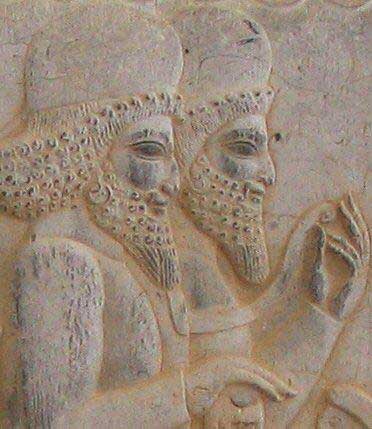
After the birth of Mandane and Cambyses’ first son, Astyages had a second dream which he interpreted as a warning against the child’s future actions. Paranoid and fearful, Astyages ordered his courtier (and fellow member of the Median royal house) Harpagus to find and kill the baby. Harpagus, although realizing that disobedience would come with grave punishment, was naturally reluctant to spill royal blood. Hoping to pass the task off to another, Harpagus gave the child to a local herdsman named Mitridates, whose own wife had just given birth to a stillborn child. Mitridates and his wife then raised the child, Cyrus II, as their own – and Harpagus presented the stillborn baby to Astyages as his daughter’s dead son.
Herodotus goes on to explain that when the boy was about 10 years old, it became clear that the child was not the son of a herdsman – his behavior was “far too noble”. Coming across the boy on a chance encounter, Astyages began to be suspicious when realized that the child looked remarkably like himself. He immediately confronted Harpagus about what he had done, and the courtier confessed. Although Astyages spared the child’s life at the advice of his Magi – and allowed Cyrus II to return to his natural parents – Harpagus was subject to a horrendous punishment: Astyages fed Harpagus his own son at a banquet.
Enraged, Harpagus waited for a chance to avenge himself and his family…
Want to read more?


Tomorrow: Part two of the Astyages story
By: The Scribe on Wednesday, August 22, 2007

Though undoubtedly taken for granted today, the number (or lack thereof) known as “zero” was not always a part of the human mathematical mindset. Since zero is more of a concept than an actual number, the development of ‘true zero’ took quite some time to enter into human consciousness.
By the 2nd century BC, the ancient Babylonians had developed their own highly sophisticated mathematical theories – however, the way they expressed the lack of a positional value (ie. nothing, zero) was by leaving a space between numerals. By 300 BC, instead of leaving a space, two slanted wedges were used as ‘zero’ punctuation, while a tablet from the city of Kish shows that at least one scribe – in this case, a man named Bel-ban-aplu – wrote his zeros by making three hook marks instead of the slanted wedges.
And yet even at this early stage, the Babylonian nothingness-placeholder was not a real zero in the ‘true’ sense of the word, since it was neither used alone, nor was it ever placed at the end of a number. For example, in the Babylonian sexagesimal system of numerals, both the numbers for 2 and 120 (since it would be 2 x 60) looked the same, and could only be differentiated through context.
Elsewhere in the world, the ancient Greeks had their own notions of what constituted zero: they were unsure of its status as a number, since they didn’t see how nothing could be counted as something… naturally for the Greeks, this vein of thinking led toward philosophical and religious arguments about the nature of zero and whether ‘nothing’ could ever be thought of as ‘existing’. As a result, the thought of zero and nothingness was an immensely terrifying concept to Greek philosophers!
 Somewhere around the 5th to 2nd centuries BC, an Indian scholar named Pingala made use of the Sanskrit word “sunya” to refer to nothing or a void, which is actually the word that finally became the word “zero” after a series of translations over time. During the 4th century in India, scholars would often use a blank piece on a counting board to physically represent zero.
Separately from these other developments, the Mayans came up with their own system of representing zero – and although it became an integral part of the Mayan mathematical system, their isolation from other cultural groups did not result in any influence on Old World numeral systems.
The first documented use of zero as a number on its own came from ca. 130 BC, when the Greek mathematician and astronomer Ptolemy began writing a small ‘o’ with a long bar overtop as a symbol for nothing. However, this form of ‘zero’ still was not used for anything but fractions. It was not until sometime between the 6th and 8th century that a symbol for zero which could be used for representing an integral part of a number appeared on copper and stone tablets in India.
Although the history of ‘zero’ as a numerical concept is much lengthier than the small portion discussed above, it is worth noting that in 628 AD, the Indian mathematician and astronomer Brahmagupta wrote his definitive work Brahmasphuta-siddhanta (translated “The Opening of the Universe”), which attempted to definite the mathematical role of zero, thus ending the debate once and for all. Of course, the nature of zero was discussed and changed long afterward, but this work sparked a new direction and is still considered a piece of highly sophisticated mathematical theory for its time.
Want to read more?


Tomorrow: Astyages (Try saying that three times fast!)
By: The Scribe on Tuesday, August 21, 2007
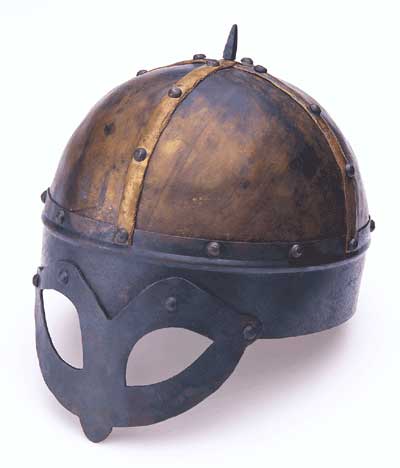
A recent study on genetics in England has revealed that ancient Britons were far more genetically diverse than those living in the country today! By studying the DNA from skeletal remains dating between 300 and 1000 AD, and comparing it to that of modern-day Brits, scientists have come to the conclusion that several deadly plagues in ancient times may have been responsible for the decline of the populace’s diversity.
Although modern England is considered to be a cultural melting pot, the 48 skeletons appeared to have even more diversity than those living in today’s continental Europe and the Middle East. However, it was after the Viking era that two severe outbreaks of bubonic plague swept across England and many parts of Europe.
The Black Death arrived and lasted from 1347 to 1351 AD, while the second outbreak that was known as the Great Plague lasted only two years, 1665-1666 AD. During the Black Death, as much as 50% of the European population is estimated to have died, with at least 1/5th of London’s population disappearing in the short span of the Great Plague.
Notably, the plagues did not affect people randomly – some people were simply resistant to the disease, while other entire villages of related families were wiped out, sometimes causing an entire genetic lineage to disappear at once. As a result, if there were many smaller populations with each type of DNA, and many died out because of these plagues, a significant number of DNA types could have easily disappeared.
Since that time hundreds of years ago, it seems that the British population has not been able to once again reach that same level of diversity. Although some scientists remain skeptical of this explanation, the results of the DNA study are undisputable – at the very least, something caused the British population’s DNA types to be significantly reduced. It certainly appears as though the ancient Britons were more tolerant of ethnic diversity than anyone had previously thought!
Want to read more?


Tomorrow: A brief history of zip…zero…nadda!
Previous page | Next page
