By: The Scribe on Monday, August 20, 2007

In the late 1300s, the inhabitants of what is now South Korea developed a new burial process for their loved ones – a method that, instead of allowing the body to decay naturally, in many cases resulted in an excellent natural mummification! Unfortunately, preservation of the bodies was the one thing these people did not want.
The people of the area believed that the body should decompose naturally, without the interference of outside factors – this included things like worms or other animals and parasites. In an attempt to maintain this natural decomposition, the body of the deceased would be laid on ice for 3 to 30 days during the mourning period, and then placed inside a double pine coffin, surrounded by his or her clothes. The coffin would then be covered in a mixture of lime soil.
However, instead of decaying, the bodies ended up being preserved – and, since no one expected that there might be mummies in South Korea, the mummies were not discovered until the summer of 2007, when construction work in the country began to increase, forcing the relocation of many cemeteries. In some cases, the burial practice led to an even better preservation of DNA than ancient Egyptian artificial mummification processes, since the absence of chemicals in the preservation process took less of a toll on the body!
The 500-year-old body of a child actually still holds samples of the virus responsible for hepatitis B, which could help modern scientists to determine if the virus has changed or mutated over the past 500 years – perhaps leading toward clues for treating the modern-day strain.
The most intriguing burial was that of a nobleman who seemed to have fallen out of favor with the area’s rulers. Inside the grave was a poem written by his wife, dating to around the same time as Shakespeare would have been writing his famous play, Romeo and Juliet – and oddly enough, the poem bears a striking resemblance what is found within the bard’s famous tragedy:
You always said we would be living together, to die in the same day
However, why did you go to the heaven alone?
Why did you go alone leaving me and our child behind?
…
I cannot live without you anymore.
I hope I could be with you.
Please let me go with you.
My love to you, it is unforgettable in this world,
And my sorrow, it is without end.
…
According to local records, the man was 32-years-old, and was the second son of the clan’s senior member, who was actually involved in a revolt against the country’s emperor. Although the lines from this poem were only a part of the entire document, a total of 13 letters, as well as slippers that had been woven from his wife’s hair, were found inside the coffin with his mummified body. It is unknown what happened to his wife after her husband’s death, however it is likely that she would have fled the area to avoid retribution from the Emperor and for the sake of her child.
Want to read more?


Tomorrow: So much for diversity…
By: The Scribe on Sunday, August 19, 2007

In the summer of 2007, a collection of ancient sea spiders was discovered in French fossil beds around La Voulte-sur-Rhone, which has previously yielded other examples of ancient sea creatures. This trove of ancient spiders, however, now fills in a 400-million-year gap in their fossil record.
The scientific term for the sea spiders is ‘pycnogonids’, and they were found during routine work in the area. The fossils were extremely well-preserved, and the specimens are described in detail inside of a paper published online through The Proceedings of the Royal Society B.
The paper talks about 70 the specimens of ancient sea spiders, divided into 3 distinct species, all uncovered in the area’s Lagerstatte, which is a type of sedimentary rock formation. During the Jurassic period – which lasted from 199.6 to 145.5 million years ago – this Lagerstatte was actually covered by water that was 200 meters deep!
Although there are plenty of modern sea spiders, their relationship to the mysterious ancient creatures has remained mostly speculative. Researchers are hoping that this large cache of fossils will help to piece together the creatures’ evolutionary history, especially considering the very distant relationship between sea spiders and “true” spiders.
The current vein of thought is that the ancient pycnogodis appear to be remarkably similar to today’s living sea spiders, even though they likely began colonizing very deep parts of the sea well before the start of the Jurassic period.
Want to read more?


Tomorrow:
By: The Scribe on Saturday, August 18, 2007
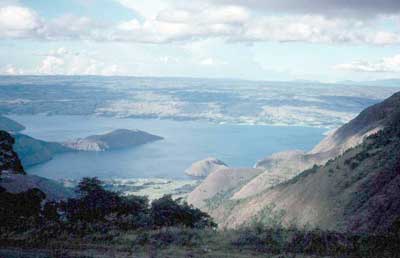
About 76,000 years ago, the volcano Toba – located in what is now Indonesia – erupted to create the largest and most devastating volcanic event of the past 2 million years. Almost 3,000 cubic kilometers of magma was spewed out, while sulfuric acid rained over the earth as far away as Greenland. The world became subject to a volcanic winter, and what followed was one of the most severe ice ages in documented history.
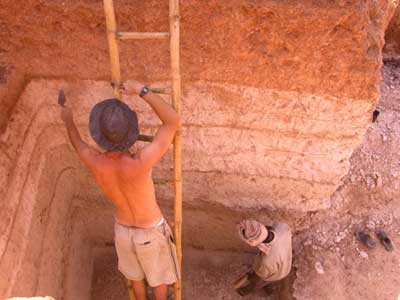
Over in India, the land was showered with 15 centimeters of volcanic ash, which can be seen today, working as a distinct age marker in the earth’s stratigraphy. And yet, contrary to all logic, archaeologists have unearthed assemblages of stone tools both above and below the ash deposit in India’s Jwalapuram Valley.
The tools look remarkably similar to those made by humans in Africa, which indicates that these tools were also human-formed – and yet, if humans were still in India after the depositing of ash (an incredible feat it itself), they would have had an extremely difficult time trying to survive. After all, the sheer magnitude of the eruption suspended both volcanic gas and sulfuric acid in the earth’s atmosphere for years, causing warm sunlight to be redirected away from Earth – and plunging the world into several centuries of temperatures that were at least 3-5 degrees C lower than normal after the event.
Along with the tools, a large piece of ochre was found – something that early humans used to create art, make symbols, cure animal hides, and sometimes help attach stone tool pieces to a wooden shaft. There are some archaeologists who are skeptical at the tool findings, believing that these did not come from what has been termed “modern” humans, but instead should possibly be attributed to an earlier hominid species – such as the European Neanderthals – which eventually died out.
While it is thought that humans had begun to develop the ability to make complex tools and form cohesive and sophisticated social behavior at this time, the notion that these early humans survived such a global catastrophe certainly paints a picture of the resilience and determined human instinct for survival that shows through human actions even today.
Want to read more?


Tomorrow: Sea Spider Fossil
By: The Scribe on Friday, August 17, 2007
As fierce and merciless as their reputation may have been, one thing is now clear: the Vikings took pride in their outward appearance. In fact, they were so concerned with looking good that they actually did something that might be considered strange to those who were not part Viking culture – they filed their teeth.
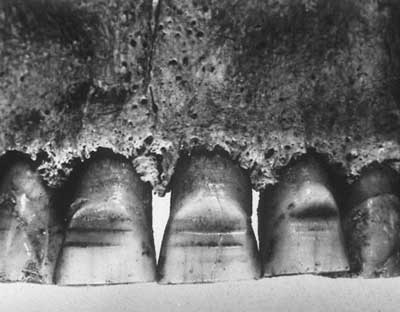
A study of 557 Viking skeletons revealed that 24 of the bodies’ mouths had deep, horizontal grooves across their set of upper front teeth. Although other cultures around the world were known to have practiced dental modification in ancient times, this is the first known occurrence of it on human skeletons from this part of Europe.
It is an interesting find, because Vikings have typically been known for their seafaring abilities and violent church and monastery raids in ancient Britain and France. Facial decoration simply does not seem to conform to the habits of gold and silver acquisition that the Vikings practiced – however, it is entirely likely that they picked up on the idea from another foreign culture.
Since the Vikings were expert seafarers, it is possible that they learned of dental modification after coming into contact with some West African cultures during one of their voyages across the Mediterranean, or perhaps even as far away as North America – the only other known place where horizontal tooth marks occur is in the Great Lakes region and several other adjoining American states.
The actual tooth markings appeared to cut quite deeply into the enamel, and the markings tended to happen either in pairs or sets of three. The consistency of the markings also rules out any suggestion of this occurring through natural wear or using the teeth as a tool – the depth of filing and the placement on the teeth indicate that the grooves are decorative and were probably done by a very skilled hand.
Why these Vikings chose to file their teeth remains a mystery, however the most likely explanation is that it was representative of an achievement. It could have been a way to socially identity certain individuals of marked status, and if filled in with colored pigment – which Vikings often used to color their faces or tattoo their own skin – they would have looked even more terrifying to the villagers they were raiding.
On the other hand, there is evidence that most Vikings spent time combing their hair and ironing their clothes with hot rocks – so perhaps filing one’s teeth was an expensive way of making oneself more aesthetically pleasing… a kind of Viking answer to modern plastic surgery.
Want to read more?


Tomorrow: Mega volcano eruption? No problem!
Previous page | Next page
