By: The Scribe on Sunday, August 12, 2007

According to the ancient Aztecs, things like beauty, love, dance, and flowers were not necessarily associated with femininity, as they are in modern times. Instead, the Aztecs had their own male god to represent these things for them: Xochipilli was the god of games, maize, dance, love, beauty and flowers, and was also sometimes referred to as “Macuilxochitl”, which actually means ‘five flowers’.
Xochipilli’s name was formed out of two words from the Nahuatl language: xochitl, which means ‘flower’, and pilli, which means ‘child’ or ‘prince’. So, the god was quite literally a “flower child” (or “flower prince”, which is somewhat less demeaning to the modern ear)! In addition, the god was married to a goddess named Mayahuel, who was responsible for looking after maguey plants and fertility – literally a ‘womb protector’.
However, Xochipilli was not solely responsible for all the flowers and dancing, instead he shared this responsibility with his twin sister, the goddess Xochiquetzal (meaning “flower feather”), who looked after fertility, games, dancing, craftsmen, flowers… and also prostitutes and pregnant women (apparently the two went hand-in-hand to the ancient Aztec mind…).

It was in the mid-1800s when a statue of Xochipilli was discovered that dated to the 16th century, and it showed a single figure sitting on a base that looked somewhat like a temple. The interesting thing is that the carvings on the side of the base, as well as on the figure itself, are not only flowers – which is, of course, appropriate for this god – but are actually psychoactive flowers and plants associated with hallucinogenic effects.
These plants include mushrooms, tobacco, sinicuichi, and several other flowers – which may explain why the figure is depicted with his head tilted upward, his mouth half open and jaw tensed, and his arms raised skyward: the statue probably depicts the god while he’s high. The expression of the body, in combination with these plants that are known to have been used by the Aztecs in sacred rituals, almost certainly support this interpretation.
Want to read more?

Tomorrow: Mosaic rewrites history
By: The Scribe on Saturday, August 11, 2007
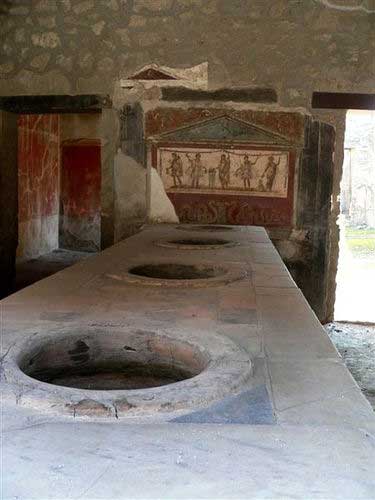
![A “fast food” stand where Romans could purchase breads and drinks.]](http://ancientstandard.com/images2/romanfastfood.jpg "A “fast food” stand where Romans could purchase breads and drinks.]")
While it’s often thought that fast food was a modern invention of a society bent on immediate gratification… well, that theory can now be placed to rest. A study on the remains found at Pompeii has revealed that, more often than not, ancient Romans ate their food while “on the run”.
Although the concept of Roman fast food eateries has been around for awhile, after excavating an entire city block from Pompeii, archaeologists realized that the distinct lack of tableware, formal dining areas, or even full kitchens in Roman homes seems to indicate that cooking – and eating together as a family – wasn’t necessarily at the forefront of ancient Roman concerns. Instead, isolated plates in various corners of the homes turned up, even in places that were previously thought to be unrelated to eating, such as in the bedroom.
This seems similar to how today’s children and adults will take a plate of food into another area of the home while working on something else, instead of always sitting down at the kitchen table to eat. In fact, many of the homes also contained mini-barbeque style implements, which would have certainly allowed someone to cook their meat faster and could eat it on the go.
In addition, there are literally remains of fast food restaurants from Pompeii. These places resemble something like a cross between McDonald’s and a British Pub, in the sense that you could purchase both food and alcohol, and could either grab it and go or sit down at little tables inside the eatery. These fast food places were open to the street, and had a large counter area with a reception area in the middle where the food and drink would be served.
Then, if you wanted, you could sit down at one of the picnic-style tables and quickly munch down your bread and hot sausage (with cheese!), or carry it off as you went about your business – or perhaps bring the food back home for the family, if the wife didn’t want to cook that evening. And while it may seem strange to think that people in ancient times could support these kinds of establishments, many of the people living in Pompeii specifically were comparatively wealthy – local artisans, shopkeepers, potters, weavers, and so on – and could therefore afford to eat out on a regular basis.
Pompeii was also a bit on the touristy side, attracting people from all over the Roman Empire, which must have helped business along as well – seemingly to the point where individuals could own more than one fast food shop, as there is a known inscription that indicates one man owned over ten “franchises” in Pompeii alone!
Based on these finds, it is extremely likely that there were also fast food shops elsewhere in the ancient Roman world, however it is doubtful that there were quite as many as there seemed to be in Pompeii. Of course, as much as the Romans liked their fast food, it should be remembered that it was undoubtedly much healthier for them to eat out on a regular basis than the choices offered to the modern consumer these days!
Want to read more?

Tomorrow: More ancient goodness
By: The Scribe on Friday, August 10, 2007

The earliest appearance of the German language came somewhere around the 6th century AD, known as Old High German, and is found from scattered ancient inscriptions know as Elder Futhark – which is essentially the oldest known form of the runic alphabet. This alphabet was used to write inscriptions on basic items such as jewelry, tools, and rune stones.
This runic language eventually developed into a more cohesive writing system, and somewhere around 765-775 AD, what is now considered the oldest book in the German language was written. The book itself is a dictionary of synonyms – similar to that of a glossary or word list – between Latin and Old High German. Only one copy of the book has survived to present day, and this is known as the Codex Abrogans.

The oldest coherent texts in Old High German date from the 9th century, and are generally works of epic poetry: the Hildebrandslied and the Muspilli, for example. Around this same period, there was also another form of German documented on the northwest coast of Germany and in parts of Denmark, spoken by the Saxons – it was called Old Saxon, or alternately, Old Low German. Only a few written texts survive from this language, mostly in the form of baptismal vows.
Middle High German made its appearance between 1050 and 1350 AD, and a good deal of texts survive from this period. It was essentially a development and transitional period for the language, while around the same period (about 1100 – 1500 AD), Middle Low German appeared around the North and Baltic Seas. In fact, although Middle Low German was quite widely spread around that area, it was not codified since a standard written language never fully developed.
Early New High German is the period of German language between 1350 and 1650, and it was this version of German that finally moved toward a standardized form of the written language – and not just written reflections of the local German dialect. When Martin Luther eventually translated the Bible in the 1520s and 30s, he based his German translation on this form of the language, which was the most widely understood version of German at the time.

Upon distribution of this Bible, supplementary lists had to be provided for each region that copies went to, in order to translate certain unknown words into the local dialect! However, the Catholic church’s opposition to Luther’s translation caused Early New High German to eventually fade, as it took until the mid-18th century before a standard of German finally became widely accepted!
As a result, standard German was almost exclusively a written language until about 1800. People living in other parts of Germany learned standard German as a foreign language, even making use of small pronunciation guides to help them speak it correctly, though this only resulted in the pronunciation varying between regions. Between 1852 and 1860, the Brothers Grimm tried to help correct the variations in German dialects by publishing a dictionary in 16 parts, which even today remains the most comprehensive guide to the German language’s wide lexicon.
In 1880, grammar and compositional rules appeared in the “Duden Handbook”, which was declared the official standard definition of the German language in 1901. Finally, the language had come into its own!
Want to read more?


Tomorrow: Fast food in Pompeii
By: The Scribe on Thursday, August 9, 2007

In the entire history of ancient Egypt, it’s a wonder that there aren’t more inscriptions or tomb paintings that depict the inevitable neck pain that must have ensued as a result of the use of Egyptian pillows. As seen in the image above, the ancient Egyptians did not use a pillow to sleep on each night so much as a headrest – and one that was uncomfortably high, no less.
Egyptian headrests were used each night to support the head while a person was asleep, and consisted of a curved upper section to cup the head on top, with one or two pillars leading downward to a flat base. These “pillows” could be made from a variety of materials, including ivory, marble, stone, ceramic or wood. There is some debate over whether or not a small cushion was placed in the curving part to make the headrest more comfortable, however there is no artistic nor written evidence thus far to support this idea.
Regardless of comfort, pillows were important both to the living and the deceased, since the ancient Egyptians tended to view death as an eternal kind of sleep – as a result, many of the headrests found in Egyptian tombs were inscribed with the owner’s name and epithets.

Another interesting feature of Egyptian headrests is that they were not only practical to get a good night’s sleep (regardless of how uncomfortable it might look to modern eyes), but they also had a religious association with the solar cult – one’s head was lowered at night and rose in the morning, just like the sun. A headrest from the tomb of King Tutankhamun illustrates this association: the base of the headrest is made up of two “lions of the horizon”, while the god Shu holds up the head’s cup, in the same manner as is seen in the Book of the Dead where the solar barque rests on a stand.
The only indication of something potentially more comfortable being used to support the head was an unusual artifact found in April 2006. It was a 4,000-year-old pillow that was made out of woven plant fibers encased in a wax coating – leading toward some speculation that perhaps some finicky Egyptian nobles eschewed the harder headrests in favor of softer comforts. Of course, this also reopened the debate over whether pillows like this were once placed overtop headrests to make things more comfortable, with all the other organic pillows simply degrading over time, leaving just the headrests for archaeologists to find.

Want to read more?


Tomorrow: A Brief History of the German Language
Previous page | Next page
