Archive for the ‘Ancient Asia’ Category
By: The Scribe on January, 2011
In the ancient world, female rulers were few and far between. While many male rulers have had spouses and consorts that were mentioned in history books, very few of these women ruled in their own right and ancient female rulers were unique enough that when they did exist, they generally received a lot of press both at the time that they ruled and in historical reports about the time that they lived in.
 One of these female rulers was born in 624 and lived in China during the Tang dynasty. Her name was Wu Zetian (or, as she is known Empress Wu) and her beginnings were surprisingly humble. Although she was born into a noble family it was not the ruling family. Wu Zetian’s beauty caused her to be sent to the palace of Emperor Tai Tsung (also known as Emperor Taizong) as a concubine. All of the reports of the time talked about her beauty, her intelligence and her wit so it was no wonder that she was chosen to hold that position in the Emperor’s court.
If power had stayed with Emperor Tai Tsung, Wu Zetian would likely have never become Empress. She was unable to bear the old emperor any children. It was the custom of the time that when an Emperor would die, childless concubines would become Buddhist nuns. But luck was on the side of Wu Zetian. It turns out that Empress Wang, the wife of the old emperor, did not want her son to be swayed by the influence of Consort Xiao. Because of this, Wu was returned to the palace and given the position of consort or concubine to Emperor Gaozong. 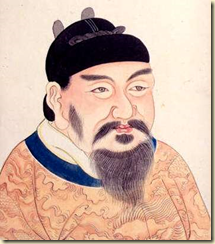
At this point, Wu began to consolidate her power. She became a favored concubine of the new emperor and bore him the male children that the Emperor wanted. She was able to eliminate Empress Wang, the Emperor’s wife, by framing her for the death of Wu’s infant daughter. Some historians claim that she may have killed the little girl herself in order to frame Empress Wang.
The ability to seize power came about five years after they were married. The Emperor suffered a stroke that left him crippled. When this happened, Empress Wu put herself into a position where she had control over the administration of the empire. Historians say that she was willing to do anything and get rid of anyone that stood in her way.
Empress Wu ruled the country officially as empress from the year 690 to 705. During that time, she established a secret police force that terrorized the country but, as time went on and she became more confident in her rule, this became less of an issue in the empire. She was a capable ruler and was able to rule well. Until her rule, Daoism had been the state religion but she changed this and instead, Buddhism became the religion favored most by the state.
In 705, Wu was deposed and the throne passed to her third son, Emperor Zhongzong who she had had exiled years earlier. Although she was deposed she was not killed. Instead, she died peacefully during that same year at the age of 80.

By: The Scribe on January, 2011
Chess is a fun and exciting game that has been played for thousands of years. It is a game of strategy and planning that can be extremely exciting to watch. Many players believed that the way someone played chess indicated how they would react on a field of battle. While many people who enjoy the game these days know that it has been around for quite some time, they may not know exactly how long the game has been played for.
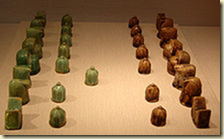 The game is believed to have originated in the northwest part of India during the 6th century. There, it was known as chaturanga and the pieces represented four different military divisions. The pieces were divided into infantry, chariotry, calvary and elephants instead of the pieces that we know and use today. The game was also being played in Sassanid Persia around this time although there it was known as chatrang instead. The pieces that appeared in the game chaturanga would eventually evolve into the modern day pawn, knight, bishop and rook pieces. Since this earlier version was based so much on the military, it is no wonder that players believed it would give insight into an opponent’s style of military strategy.
As the game spread throughout Europe, its name changed several times until it ultimately became known by the Persian word “shah” or “king”. The word “checkmate” came from the phrase “shah mat” or, “the king is dead”.
Although the game was initially viewed as a curiosity and the pieces were often collected as curiosities rather than as game pieces, chess was being played throughout much of Europe by about the 9th century CE. In fact, it was believed that Muslim traders actually brought carved chess Kings to Europe years before the game itself became popular. By 1000CE, the game had spread completely through Europe and was appearing in literature and instruction manuals such as the Libro de los juegos, a famous 13th century manuscript that included instructions on how to play other games as well.
The rules and pieces that we recognize today began to appear around the year 1200 CE although many of the major changes that took place were not made until around 1475 CE. The queen had not existed as a piece until this point. She replaced a piece known as the vizier and, although she appeared around the end of the 10th century she was not the most powerful piece until around the 15th century CE.
Once many of the rules became standardized, it was not surprising that books on strategy began to appear. These writings appeared in the 15th century CE and several of the most important early books were written by Spanish authors. These books began to analyze games and suggest different opening strategies that may have helped players achieve victory.
Chess continues to be played in many countries. Newer versions of the game have been named “Queen’s Chess” (due to the powerful nature of the queen as a piece) and “Western” or “International Chess” due to the fact that rules about stalemates were developed in Western Europe during the 19th century CE.
By: The Scribe on December, 2010
Many people have looked at beautifully decorated silk shoes from China and wondered if they were for a child or a doll. They are surprised to find that these pairs of shoes, some of which are only a little over three inches in length were actually meant to be worn by grown women. But how could a woman get her feet that small? Extremely small feet were achieved through a process known as foot binding.
Foot binding was first practiced in about the 10th century. The process was a lengthy and dangerous one and many girls actually died from having their feet bound. The arch was often broken and the toes folded underneath and bound into place. This was started before a girl’s feet had time to fully form. The average age that girls began the process was anywhere from four to seven years of age. If a girl was lucky, the process would be performed during the winter. Cold weather could numb the feet and help to ease some of the pain. 
The process of binding the feet to make them as small as possible would take years to complete. They were unwrapped often and cared for. It was not uncommon for gangrene to set in and for the flesh to rot in some areas. Foot care took place daily in rich families but may have only taken place once or twice a week in families that were less financially well off.
The ideal length for a woman’s foot was three inches long. Women who had longer feet were often considered less desirable and may not have been able to marry as well as women with perfectly bound feet. A woman who had her feet bound could walk on them although it was difficult. In fact, women who were from a higher social class were often more likely to have their feet bound since it showed that the family was affluent enough to afford servants.
There have been many stories that explained the origin of foot binding. One legend states that Yao-niang, a consort of the ruler Li Yu had performed a dance on feet that had been wrapped in silk cloth. This type of foot wrapping was very similar to the toe shoes that ballet dancers wear today. It became desirable to have feet shaped like a crescent moon.
Although it was believed that all women in China had bound feet this was not always the case. Some ethnic groups only bound feet enough to narrow them and did not break the bones in any way. Manchu women did not have their feet bound at all after the year 1644 due to the fact that the Emperor had forbidden it.
Foot binding in some form was practiced for approximately 1000 years. Women who were born as late as the 21st century had their feet bound although the practice was outlawed in 1949. Some women who had bound feet did remove their wrappings but this also caused great pain and left the women disabled. There are still women who are living in China today who have the distinctive small feet that were once so prized for a thousand years.
By: The Scribe on December, 2010
Many ancient cultures had traditions of placing things in the grave of someone who died. This could be as simple as placing containers of food in with the deceased or as extreme as killing slaves and family members. Whether it was furniture, food or servants, the entire principal was to provide the deceased with tools and items that they could use when they reached the afterlife. These were often personal items although they may also have been heavily ornamented and, in the case of some ancient rulers, were often extremely valuable.
Funerary art and grave goods were also placed in graves as a way to honor the deceased and to celebrate the accomplishments that they achieved in life. This meant that some ancient leaders would have large quantities of grave goods and funerary art pieces placed in their tombs when they were being buried.
This practice of adding items to the grave was often done on a fairly small scale in terms of size even if there were large numbers of individual items. Miniatures of furnishings, homes and other items were lovingly crafted and placed in the graves or tombs. Some cultures placed many items in tombs especially if the person who died was extremely important or powerful.
Perhaps the most elaborate example of placing items in a tomb would have to be the Terracotta Warriors of China. Found in 1974, this collection of beautifully crafted figurines dates from 210 BCE and is made up of more than 8,000 individual pieces. These figurines were located near Xi’an, the capital of Shaanxi province in China.
The figures are much larger than other funerary statues that are normally found in tombs. Instead of being miniature, they are life sized and, in some cases, are actually larger than life. The smallest figurines are approximately 6 feet tall but some measure up to 6.4 feet tall. They are very detailed and show a variety of different professions. In addition to the 8,000 soldiers figurines of acrobats, cavalry horses and horse and chariot combinations were also found. Each of the figures is unique. This uniqueness is due to a direct order from the Emperor who did not want the figures to be duplicated at all. It is because of this attention to detail that the collection took many years to complete.
The figurines were part of a larger necropolis, a city for the dead that was built to honor the Chinese Emperor Qin Shi Huang, the first emperor of China. The creation of the mausoleum and the necropolis was a massive project that involved as many as 700,000 workers. The necropolis and the army were meant to serve two different purposes in the afterlife. The necropolis had been designed to act as a palace or imperial compound. 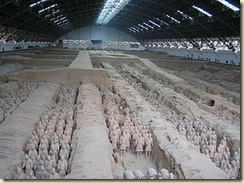
There are several theories about the purpose of the army. The first is that the army had been designed to act as protection for the emperor in the afterlife. The second theory was that the army was provided for the use of the emperor so that he could continue to attack and conquer others even in the afterlife.
The terracotta warriors have become an international sensation and portions of the collection have been taken on a tour that has stopped in many countries around the world.
Previous page | Next page
 One of these female rulers was born in 624 and lived in China during the Tang dynasty. Her name was Wu Zetian (or, as she is known Empress Wu) and her beginnings were surprisingly humble. Although she was born into a noble family it was not the ruling family. Wu Zetian’s beauty caused her to be sent to the palace of Emperor Tai Tsung (also known as Emperor Taizong) as a concubine. All of the reports of the time talked about her beauty, her intelligence and her wit so it was no wonder that she was chosen to hold that position in the Emperor’s court.


