Archive for the ‘Ancient World’ Category
By: The Scribe on April, 2011
While Easter is an important time due to its’ religious associations, many of the secular symbols that are used to represent the holiday have ancient meanings that predate the religious observances that take place during this time.
The name Easter comes from the goddess Eostre, whose name was used to mark a month in the Anglo-Saxon calendar that was roughly equivalent to April. The name was used to identify this time of the year well before 899 CE and was mentioned by Bede, an English monk who lived from 672 CE to 735 CE. Eostre was a fertility goddess who was believed to be connected to fertility and growth. 
One common event that many people take part in during Easter is an Easter egg hunt. The Easter egg is actually a pagan symbol that is used to represent the Earth being reborn in the spring. Some of the most well-known decorated eggs are pysanky which come from the Ukraine. This traditional method of decorating eggs involves covering a raw egg in wax to create patterns and then dipping the egg in a series of dye baths. After each dye bath, the egg is once again coated in wax in order to preserve different colors and build further layers into the pattern. In the Ukrainian tradition, the yolk of the egg represents the sun and many of the symbols that are used relate to the worship of the sun god Dazhboh. It is believed by some Ukrainians that the world will end if people stop decorating pysanky.
In Medieval Europe, one was not allowed to consume eggs during Lent which was a time for sacrifice, prayer and self-denial. Because eggs were still being produced by chickens during this time, it was necessary to preserve them so that they would not go to waste. Because of this, eggs were often boiled in order to keep them from going bad. They were then served as part of Easter dinner and were given as gifts as well. Eggs are included in many different religious ceremonies as well.
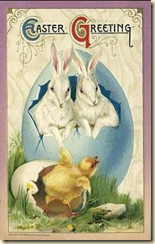 The Easter Bunny is one of the most widely recognized secular symbols and is the one that most children look forward to the most. Now, he is known as someone who leaves behind baskets of candy, chocolate and gifts for children to enjoy. In some countries, the Easter Bunny is known as the Easter Hare or the Spring Bunny. The tradition of the Easter Bunny was brought to the United States by German settlers in the 18th century. Historically, rabbits and hares have been symbols of fertility for much longer than that. This is due to the large litters that both animals give birth to.
In many cases, religious legends and ancient traditions have been combined. The Easter egg is one example of this. According to some legends, Mary approached the soldiers who were at the cross when Jesus was crucified. She gave them eggs and wept as she begged them to be less cruel. When her tears struck the eggs, they became decorated with spots of color.

By: The Scribe on February, 2011
In many ancient cultures, rulers not only had wives. Depending on the culture that they belonged to, they may have kept concubines as well. These were women who served many of the same purposes as wives but as concubines, they were unable to marry the men that they served for a variety of reasons. Many women who served as concubines were commoners or even slaves and, because of their lowly social status, it was impossible for them to marry the ruler that they served.
 Often, the concubines were kept in seclusion and were not accessible to males other than the ruler whom they served. In Muslim cultures, this area was known as a harem. In some cultures, wives may have lived with the concubines. In other cultures, the legal wives may have lived separately from the concubines. Although Muslim harems are among some of the best known settings where concubines existed, the Muslims were not the only culture to keep women who filled this role.
In many stories, the concubines a ruler had were taken by force and sold into their life but this was not always the case. It was not uncommon in some cultures for poorer families to present their daughters to a ruler in order to see if they would be chosen as a concubine. This often served the dual purpose of getting rid of an extra mouth to feed as well as giving their daughter a life of comfort, privilege and protection.
One example of this was Consort Wu. She was the consort and favorite concubine of Emperor Zuanzong of China. Known for her beauty, she rose to the position of Huifei, the highest rank that a concubine could achieve. After the Emperor’s wife died in 724 CE, Consort Wu was treated like an Empress by all of the servants living in the palace. Although she was treated as a wife by the Emperor they were never formally wed.
Concubines often bore children to the rulers that they served. In some cases, these children were treated as legal offspring especially if the concubine or consort was an official one that was recognized by a court. Some concubines also enjoyed a measure of fame apart from their status as consort to a particular ruler. 
While life could be good for a concubine, if they failed to bear children it often became less pleasant. In some cases, when the ruler that they served died, childless concubines were expected to die as well. In the case of Emperor Qin Shi Huang, the first Emperor of a unified China, his Imperial consorts were sealed up in his tomb to serve him in the afterlife.
Concubines also appeared in the Bible as well. The Israelites often kept concubines in addition to their lawful wives and these women enjoyed the same rights and privileges as the legitimate wives did. In the Bible, wives had dowries but concubines did not and this was the chief method of distinguishing between the two social positions. One of the most famous keepers of concubines in the Bible was King Solomon, who lived from 1011 BCE to 931 BCE. According to Biblical records, he had three hundred concubines in addition to his seven hundred wives.
By: The Scribe on February, 2011
These days, if you see a red and white (or red, white and blue) barber pole, you know that it means a haircut and, possibly, a shave as well. But in the middle ages, the pole meant something completely different. Barbers were often tasked with performing surgery or treating the ill just as often as they were involved in the care of someone’s hair or beard.
 Barbers have been practicing their trade for many years. Early razors made of bronze have been found that date back to 3500 BCE. In some cultures, care of the hair was a religious matter. A barber was able to prevent certain evil spirits from entering a person’s body through their hair. Before shaving became common, men still needed to have their beards trimmed and cared for and barbers would perform these functions. It was not uncommon for a barber shop to be set up in a public market and they often became social gathering places as well as places to have their hair tended.
In modern medicine, physicians often diagnose and treat illnesses and injuries. This was not the case in medieval times. Physicians were more scholarly than they were practical and it was as much an individual’s ability to debate and lecture that made them a physician as it was any general ability at medicine.
The way that illnesses and injuries were treated was also very different. While people were studying anatomy and various illnesses themselves, it was also believed that illnesses were sent as a punishment from God. If patients performed penance or went on a pilgrimage it was believed that they would get better. Prayer was believed to be as valuable as herbs and other medicines when it came to helping a person recover from illness.
Barbers often concerned themselves with the practical side of treating illness and left the spiritual aspects to the priests and monks. They often performed procedures ranging from leeching and dentistry right up to surgical procedures such as amputations, hernia repairs and gallstone operations. Surgery was a nightmarish affair because up until the discovery of anesthetic, operations were performed on conscious patients. Procedures needed to be performed as quickly as possible so that patients did not die from blood loss or pain.
In order to show that he had set up shop, a barber would place a red and white striped pole out in front of their shop. This tradition carries through today although in the USA, the pole has red and blue stripes. The pole actually refers to the barber’s dual roles of medicine and hair care. The red strip refers to the surgery aspect of the trade and the white refers to the process of caring for someone’s hair.
If you look at an original barber pole, you will see that there is a wash basin at the top. This was usually made of brass and represented a container where leeches would be kept. There is also a second basin at the bottom of the pole which represents the container which would catch any blood that was produced during treatment.
By: The Scribe on February, 2011
Today is Valentine’s Day and millions of people will be buying chocolates and other gifts to show their love for each other. Although it seems like this day is simply a tool of the greeting card companies, the truth is that this day has a long history that dates back to the year 496 CE. It was then that Pope Gelasius I chose to establish a day to celebrate love and affection between companions.
 The day itself was named after an early Christian martyr who was buried on February 14th. There have been several stories about the identity of Saint Valentine, the man for whom the day was named. One version of Saint Valentine’s history says that he was a priest during the reign of Claudius II. Claudius was not an Emperor that was positively disposed towards Christians. Saint Valentine was caught and imprisoned because he was aiding Christians and allowing them to escape imprisonment and torture.
Another version has Saint Valentine marrying Roman soldiers in secret. Emperor Claudius had decreed that soldiers needed to remain single because he believed that they would make better soldiers if they remained unwed. When Saint Valentine was caught performing marriages, he was put to death.
Another belief is that Saint Valentine’s Day was established as a way to turn worship away from the celebration of Lupercalia. This was a fertility rite that was performed at the beginning of February. In the Roman calendar, Spring began at the beginning of February. Lupercalia involved the ritual slaughter of two goats and a dog. The skins were removed and cut into strips. These would be used to strike girls and young women as a way of increasing their fertility for the coming year.
While the day was dedicated to love by Pope Gelasius, it was not the romantic love that is celebrated today. The celebration of romantic love on Valentine’s Day did not begin until the Middle Ages. It was the writer Geoffrey Chaucer and not the greeting card companies that shifted the focus from friendly love to romantic or passionate love. It was during the fourteenth century that Chaucer and his friends began to popularize this concept.
The first written Valentine cards and greetings did not appear until after 1400 but the day was not popular until the seventeenth century. Once it caught on, however, it was not long until it became common for friends and lovers alike to exchange cards and small gifts. These started out as written letters but as printing methods improved, the hand written greetings rapidly changed to ready-made cards. These started to be produced en masse in the 1840’s.
Now, some individuals go to great lengths to celebrate this day. It is no longer known as Saint Valentine’s Day after being removed from the Catholic calendar of saints in 1969. Although many people are tired of being gifted with mass-produced boxes of chocolates and mass-produced greeting cards it is likely that they would still prefer these items to being struck with bloody strips of goat skin.
Previous page | Next page
 The Easter Bunny is one of the most widely recognized secular symbols and is the one that most children look forward to the most. Now, he is known as someone who leaves behind baskets of candy, chocolate and gifts for children to enjoy. In some countries, the Easter Bunny is known as the Easter Hare or the Spring Bunny. The tradition of the Easter Bunny was brought to the United States by German settlers in the 18th century. Historically, rabbits and hares have been symbols of fertility for much longer than that. This is due to the large litters that both animals give birth to.