By: The Scribe on Friday, April 15, 2011
When you mention the Second Punic War, there is a good chance that few people will know what you are talking about. Mention Hannibal and his elephants, and you start getting many more people who have any idea what you are referring to. However, Hannibal taking his elephants over the Alps is only part of what was known as the Second Punic War, which lasted from 218 BCE to 202 BCE. A first Punic War had taken place from 264 BCE to 241 BCE.
Hamilcar Barca, Hannibal’s father, was a military commander who led Carthaginian troops during a portion of the First Punic War. He also led Carthaginian troops successfully during several other battles and ultimately ended up dying in battle in 228 BCE. His hatred of Rome and his desire to defeat them in battle is believed to be one of the things which shaped Hannibal’s mentality and caused him to head from Carthage to Italy with his elephants in tow.
 After crossing into Italy, Hannibal had managed to defeat the Roman military in several battles: the Battle of the Trebia and the Battle of Lake Trasimene. The Romans were not used to being defeated in battle and were not overly pleased that Hannibal had managed to win two battles. Because of this, they decided to appoint Fabius Maximus, a Roman politician, to the position of Dictator in order to handle the problem. This meant that he was able to take measures beyond those normally allowed a military commander in order to deal with threats to the Empire.
Fabius decided he wasn’t going to take Hannibal on directly. After all, doing so had simply led to Roman defeat and Maximus was not interested in having that happen while he was in charge. He ended up cutting off supply lines and avoiding any pitched battles against the Carthaginians. As a result of these tactics, Hannibal was able to regroup and prepare for a fight. Hannibal was able to hang around in Italy, enjoying the terrain and preparing for battle against the Romans. After all, if they wanted to go home, they would have to go back over the Alps and no one was really interested in making that trek again.
Finally, the Romans decided to put an end to Hannibal’s Italian tour. They gathered eight legions together along with allied troops and members of the cavalry. Approximately 90,000 Roman troops took the field against Hannibal’s total of 45,000 troops. The battle was to take place in 216 BCE at a town known as Cannae.
The battle was brutal. According to some historical accounts, the Romans outnumbered the 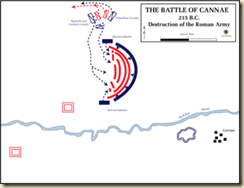 Carthaginian troops and were armed with typical Roman arms and armor. The Carthaginians were armed with a variety of different weapons and protected by a variety of different types of armor. Hannibal was able to encircle the Roman forces and catch them in a pincer movement. They trapped the Romans and were able to slaughter them. It was reported that only 14,000 Roman troops were able to escape the battle.
Cannae remains perhaps the most massive and terrible of all Roman military losses and ended up causing Rome to completely rearrange and rethink its military structure.
By: The Scribe on Wednesday, April 13, 2011
One thing that the Romans never seemed to learn was the principle of choosing your friends carefully. Throughout Roman history, there were a number of cases of former allies rising up and fighting against both the Republic and the Empire. One of the most notable was the Battle of the Teutoburg Forest, in which a collection of Germanic tribes fought back against Roman soldiers and managed to slaughter several legions’ worth of troops. What made this battle worse was the fact that Arminius, leader of the Germanic forces, had actually been made a Roman soldier and a minor noble. You would think that Rome would have learned from this mistake but alas, it apparently did not.
 The year was 378 CE. Two years prior, in 376 CE, the Roman Emperor Valens had thought he would do a good thing by allowing Goth tribesmen to settle in Roman territory. Oh sure, the Goths had fought against the Romans in the past, but surely by giving them land, they would earn the appreciation of these tribes and be safe from any further attack, right? Wrong. Ultimately, the Goths would overrun Rome and lead to the downfall of the entire Roman Empire.
One could argue that the Romans brought it on themselves. Things may have turned out very different for both Rome and the Goths if the provincial commanders hadn’t shown themselves to be completely dishonest. The Goths found life in their new territories to be incredibly harsh and finally they had enough. They revolted and fought against the Romans in the running battles that tribesmen tend to be good at and Roman legionaries tend to have problems with.
The Goths again asked for land. This time the Goths were denied which set things in motion and which would ultimately lead to the Battle of Adrianople. It is not totally certain how many troops were fighting on behalf of Rome but it is estimated that Roman troops and allies totaled a maximum of about 45,000 soldiers. They were veterans but when faced with 50,000 Gothic cavalry and between 12,000-and 15,000 other troops as well. These were not good odds for the Romans.
On August 9th, 378 CE, the Romans and the Goths squared off. The Goths had been  camped on top of a hill near Adrianople. The Romans had to march for seven hours in order to reach the field of battle and the terrain was incredibly difficult to move through. Because the Gothic cavalry wasn’t there at the beginning, the Romans were overeager and attacked before they were ordered to. Suddenly, the Gothic cavalry returned, surrounded the Roman troops and massacred them.
In the end, Valens was abandoned by the troops who were supposed to guard him. It is believed that he was killed on the field of battle although it is not certain that this is what happened. In the end, many experienced officers and troops were killed in the battle and this may have led to the eventual downfall of the Roman Empire as a whole. Suddenly the Goths went from being thought of as disorganized rabble to a dangerous adversary that could destroy Rome totally.
By: The Scribe on Monday, April 11, 2011
One thing that the Roman army was known for was its’ power. Many people thought that the Roman army with its’ strict organization, structure and equipment was virtually unstoppable. There were times that the Roman soldiers were defeated by the enemies that they faced. One battle that goes down as a spectacular failure on the part of the Romans was the Battle of the Teutoburg Forest.
 The Teutoburg Forest is located in what is now known as Germany. The terrain is made up of low mountains and the area is divided into two different portions by a valley. In 9 CE, the terrain was ruled by Germanic tribes that had formed an alliance against the Romans. The Germanic forces were led by Arminius. He was chieftain of the Cherusci and lived from 18 BCE to 21 CE. Arminius was actually able to achieve Roman citizenship during his lifetime but he chose to return to Germania and worked to drive the Romans out of the area. He became a symbol of the Germanic fight against Rome.
The Romans were led by Publius Quinctilius Varus who lived from, 46 BCE to 9 CE. Varus had a political career that saw him holding positions such as consul junior as well as governor of Africa and Syria. In Syria, he led four legions and was known for being a harsh ruler. He occupied Jerusalem and crucified approximately 2,000 Jewish rebels. He may have been one of the reasons for the strong anti-Roman sentiment that was common in the Judea.
In 9 CE, Varus was stationed near a river in Germania known as the Weser River. He had three legions of troops with him as well as a number of auxiliary troops as well. They were ambushed by Arminius, whom Varus trusted due to Arminius’ Roman citizenship. The terrain in the area was not suited to the fighting style of the Roman legionaries. It was swampy and heavily forested. After three days of fighting, the Romans were overwhelmed by the Germanic troops in an area known as Kalkriese Hill.
The legions were totally defeated. Even soldiers who fled the area were tracked down and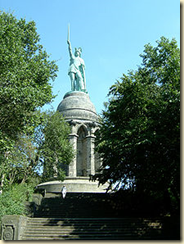 killed. Some were killed in battle while others were burned alive after being placed in cages made of wicker. Others were turned into slaves or were ransomed off. Varus, commander of the Roman forces, committed suicide after it became obvious that the Roman troops were being completely destroyed.
When the dust settled, the Roman troops were shamed by their defeat. They were never able to rule the north or the east of Germany although they did retaliate against the Germanic tribes using eight legions to massacre the people of Germania and to capture the wife and son of Arminius. Arminius escaped capture and ultimately had to deal with inter-tribal conflicts and internal strife. In the end, Arminius was murdered by members of his own tribe.
To this day, the Battle of the Teutoburg Forest is still remembered as one of the worst Roman military defeats in the history of the empire.
By: The Scribe on Friday, April 8, 2011
There have been many plagues that have rocked the world throughout the past. Some plagues, like the Black Death that killed as much as half of Europe, are widely known. Other plagues, like the Plague of Athens are known more by historians despite the fact that they caused massive amounts of death and suffering in their own right.
 The year was 430 BCE. The Peloponnesian War was in full swing. It had started a year earlier. Athens and the other members of the Delian League were fighting against Sparta and the rest of the Peloponnesian League. The war was terrible. There were many atrocities committed by the forces on both sides. The city states abandoned the formalized combat that had been so common during Greece’s Golden Age and went at each other without mercy. They destroyed the countryside and destroyed cities in their hunger to win.
The war seemed like it was going well for Athens. The forces were fairly evenly matched in some ways. Sparta’s forces were devastating on land while Athens dominated the seas. While Sparta was launching attacks by land, Athens was busy sneaking in by sea and attacking cities along the coast. Then, in the second year of the war, disaster struck Athens. It was 430 BCE and the Athenians were holed up behind Athens’ city walls.
People from the surrounding area began to move into the city of Athens itself. Suddenly, the crowded conditions became a great place for illness to multiply. The illness was very contagious and people began to die at an alarming rate. As people became ill, law and order in the city began to break down. People suddenly began to ignore the laws or go on wild spending sprees.
The plague caused the eyes to become red and inflamed. The breath became fetid as  individuals bled from the throat and tongue. They started to sneeze and became hoarse. Victims felt that they were burning from within although they were not hot to the touch. The skin became red and developed pustules and ulcers. They often took seven to eight days to die. If they did not die, they often recovered but lost fingers, toes or eyes.
People who tended the ill were at great risk of getting sick themselves. Because of this, it was not uncommon to find that people were left alone once they became sick. They were often left to die in buildings or in the street. Some were dumped into mass graves or burned on communal pyres. In fact, the flames from the pyres were so large that they caused the Spartans to back away from the city in an attempt to avoid catching the plague.
It returned several times during the Peloponnesian War. At the end, Athens was crushed and reduced to a shadow of its former glory. While they did try to rally and mount a final attack in 415 BCE, they were never able to defeat the Spartans.
It is still not known what the Plague of Athens actually was. Scientists are fairly certain that it was not caused by the bubonic plague as was thought in the past. Scientists are now thinking it may have been a mutant form of some other illness that has not been seen since it last appeared in 427/6 BCE.
Previous page | Next page
 After crossing into Italy, Hannibal had managed to defeat the Roman military in several battles: the Battle of the Trebia and the Battle of Lake Trasimene. The Romans were not used to being defeated in battle and were not overly pleased that Hannibal had managed to win two battles. Because of this, they decided to appoint Fabius Maximus, a Roman politician, to the position of Dictator in order to handle the problem. This meant that he was able to take measures beyond those normally allowed a military commander in order to deal with threats to the Empire.
  Carthaginian troops and were armed with typical Roman arms and armor. The Carthaginians were armed with a variety of different weapons and protected by a variety of different types of armor. Hannibal was able to encircle the Roman forces and catch them in a pincer movement. They trapped the Romans and were able to slaughter them. It was reported that only 14,000 Roman troops were able to escape the battle.


