By: The Scribe on Wednesday, April 6, 2011
When looking at a jellyfish swimming in the water, it is not hard to imagine that they are the leftovers from some strange, prehistoric creature. It may not surprise you to learn that the oldest jellyfish date back to approximately 505 million years ago. What may surprise you is that these early specimens were found in Utah. While the area is now known for its dry, desert-like climate, it was a different story in prehistoric times.
 Jellyfish fossils are incredibly rare. The creatures are mainly composed of soft parts and lack the bones that are more commonly preserved in the form of fossils. However, the fine sediment that was present in prehistoric Utah created an environment where the soft shape of the creature was preserved. There were many details present in the fossil. Archaeologists were able to see the bell, the tentacles and the muscle scars that made up the creature. The fossils were discovered by Richard D. Jarrard and Susan Halgedahl, both from the University of Utah
What is amazing is how highly evolved (for a jellyfish) the fossil appears to be. There were many similarities between the 500 million year old specimen and the creatures that are currently alive and stinging swimmers in modern waters. While scientists believed that jellyfish evolved slowly over millions of years, the fossils found in Utah present several alternate possibilities.
The first is that jellyfish evolved very quickly. This may have been because of the presence of warm, shallow seas. It was believed that these conditions, present during the Cambrian period, actually led to the evolution of many different aquatic life forms. Another theory is that the jellyfish did evolve slowly over an extended period of time but that these unique creatures are actually much, much older than scientists originally thought they were. The Cambrian period lasted from 542 million years ago to 488 million years ago (approximately).
The jellyfish discovered in Utah were tiny and measured less than half an inch in size. The  location of the fossils also suggests that they lived in fairly deep water. The similarity to modern species suggests that they lived in much the same way: swimming around hunting for food.
Modern jellyfish are among some of the most durable and enduring creatures. Some travel from one body of water to another by traveling in the bilge areas of ships. Massive specimens have been found in Arctic waters. All around the world, run-ins with these creatures have resulted in pain and (in some cases) death when swimmers or divers had encounters while swimming.
Since humans have only existed for about half as long as jellyfish it is reasonable to believe that we have likely been dealing with these creatures all along. A jellyfish sting can cause massive pain, nausea and vomiting. Some will cause muscle spasms or numbness and, in severe cases, can also cause breathing problems. Some individuals will even slip into a coma and die.
We now know that it is possible to treat a jellyfish sting with vinegar or, in a pinch, urine. You have to wonder what prehistoric humans would do in order to treat the stings and minimize the pain and swelling. Hopefully they had some vinegar on hand.
By: The Scribe on Monday, April 4, 2011
In the 1300’s, Asia and Europe were in the grip of one of the most terrifying illnesses ever: the Black Death. The Black Death (or the bubonic plague as it is often known today) swept through towns and villages and killed millions of people in a relatively short period of time. It started in Asia and China in about 1346 CE but had spread to Europe less than one year later. Sicily was the first city in Europe to report infection. The first reported cases were reported in October of 1347 CE.
 For someone infected with the plague, the suffering was horrible. It usually began with a headache. The infected person was usually exhausted and unable to move around much. Often, their back would hurt and they vomited. Their arms and legs would ache. Then, they would develop red spots and swellings on their body. The swellings, called buboses, would turn black and split open and the victim would begin to experience internal bleeding. The plague was easy to spread and entire families would become infected in a very short period of time.
Other forms of the plague accompanied the bubonic plague. Some people suffered from the pneumonic plague which was spread via coughing or sneezing. They had different symptoms but the outcome was the same: almost inevitable death.
By today’s standards, a disease (especially an incredibly contagious one like the plague) can spread internationally in only a few hours. Now, one infected person can simply hop on a plane and hop from country to country bringing illness and even death with them in a relatively short time. This was simply not the case back in the 1300’s. That being said, although it was incredibly easy to contract the plague, the speed at which it spread was terrifying. After all, in the 1300’s, travel took an exceedingly long time.
In the 1300s, trade was conducted between Asia and Europe along what is known as the Silk Road. This was a combination of roads and sea routes that made it easy to transport goods such as silk and spices from producers in Asia to the eager markets in Europe. Accompanying the goods along their journey were rats. Rats have fleas and it was these fleas that helped spread the plague from victim to victim.
In 1347, the siege of Caffa took place. This was a trading post manned by Genoese merchants by Turkish soldiers. The Turks were suffering from the plague and took advantage of a unique and devastating weapon. Using siege machines, they flung bodies of individuals who had succumbed to the plague over the walls. This broke the siege. The Genoese fled, but took the plague with them back to Europe.
There, the effect was devastating. People were falling ill and dying at an alarming rate. Their bodies and the bodies of those who were not yet dead were flung into open pits instead of being buried properly. Houses were boarded up and burned with individuals still inside. Everywhere, people prayed to God to save them. Slowly, Europe and Asia recover even though it claimed a third to a half of Europe’s population before it was through.
By: The Scribe on Friday, April 1, 2011
April 1st is known in many countries as April Fool’s Day. What many people do not realize is that this day has had a long history and was actually mentioned for the first time in 1392 CE, as part of Chaucer’s Canterbury Tales. The Canterbury Tales was a collection of stories written by Geoffrey Chaucer, an English poet who lived during the Middle Ages. Because of the popularity of The Canterbury Tales, Chaucer is widely known as the father of English literature. 
April Fool’s Day was first mentioned in The Nun’s Priest’s Tale. It was 626 lines long and features talking animals including Chauntecleer the Rooster. Chauntecleer went on to become a popular character in many other tales that were written later. In the story, Chauntecleer was tricked by a fox. The tale is set Syn March bigan thritty days and two. Many people believe this meant the date April 1st (32 days after the month of March began) although many scholars believe that it actually was supposed to mean 32 days after March finished, which would have been May 2nd instead of April 1st.
Regardless of which date Chaucer intended, April 1st became a day for celebration and the playing of harmless pranks. It was first referred to as Poisson D’Avril by a French poet in 1509. The term poisson d’Avril actually meant April fish, and was meant to refer to a person who had been duped by an April fools prank. They were often marked by a tag shaped like a fish which was placed on the backs of people who had been fooled.
In the Middle Ages, the New Year was actually celebrated near the vernal equinox by many cultures. This meant that it would be celebrated any time between the 20th of March and the 5th of April. Then, the Julian calendar was adopted in many areas. According to this calendar, April 1st was set as New Year’s Day. Because of this, April Fool’s Day became a holiday and a day for celebration. This continued until 1582 when the Gregorian calendar was introduced and New Year’s Day was set as January 1st instead of April 1st. It took some time for the word to spread and individuals who celebrated their New Year’s Day on January 1st also referred to the individuals who continued to follow the Julian calendar as “April Fools”.
 Documented historical pranks included the sending of servants on foolish errands (documented by Flemish poet Eduard de Dene in 1539), and a prank that drew several individuals to the Tower of London to see the lions washed in 1698.
People still celebrate the day differently in various parts of the world. In some countries, the pranks can only be played on others until noon. If a prank is played on someone after the stroke of twelve, it is the prankster who then becomes the fool. In other countries, the day is celebrated all day long and pranks can continue no matter what time of day it happens to be.
By: The Scribe on Wednesday, March 30, 2011
Translating ancient languages can be difficult if there is no method of unlocking them. Archaeologists may have still been puzzling over ancient Egyptian hieroglyphics if it wasn’t for the Rosetta Stone. This was a stone that had text written on it in Ancient Egyptian hieroglyphs, demotic script and Ancient Greek. Although there were some differences between the three languages, they were similar enough that it was possible to translate back and forth between the three written languages.
 Archaeologists discovered another similar piece of inscription on Mount Behistun in Iran. Unlike the Rosetta Stone, where the author is unknown, it was very clear that the author of the Behistun Inscription was none other than Darius the Great, the man who ruled the Achaemenid Empire. The empire included Egypt, Balochistan and even parts of Greece. The inscription was one of the many massive projects that Darius undertook. Many of his other projects were architectural in nature. During his reign, Darius constructed palaces in Persepolis and Susa and also linked the Red Sea to the Nile river by means of a canal. This was completed and opened in 497 BCE. While the piece was first discovered in the mid 10th century, it was not until 1598 that it was mentioned to Western scholars.
The inscription was written in Old Persian, Elamite and Babylonian. Translating it would prove to be very difficult for several reasons. One was the obscure nature of some of the languages that made up the inscription. The second was the positioning of the inscription itself. While it is quite large (the entire piece measures 15 meters high by 25 meters wide) it is located 100 meters above the ground. There is a ledge that runs below the inscription but the area is hard to get to as individuals who want to study the inscription need to deal with a limestone cliff that makes it difficult to reach the inscription. Some areas of the inscription are difficult to reach because of the presence of chasms, but scientists have constructed bridges in order to reach the areas that could not be recorded in the past.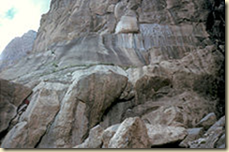
While the majority of the inscription is text, there are some illustrations as well. The piece features several bas-reliefs. One is of Darius I, the Great. In the piece, he is shown with a bow in his hands, an ancient symbol or sign of kingship. He has his left foot resting on the chest of a figure who is lying before him. This is believed to represent Gautama (a magus who was believed to have impersonated a relative of two ancient Persian kings).
The inscription has had to withstand more than just weather and time. Like many of the monuments in ancient Egypt, the inscription also sustained damage after being used for target practice during World War II. Starting in 1999, archaeologists began to document the inscription and the damages it suffered. They are using photographic methods to record the inscription and preserve it in case the site became damaged further in the future. They are also attempting to conserve it and have turned the site into a UNESCO World Heritage Site.
Previous page | Next page
 Jellyfish fossils are incredibly rare. The creatures are mainly composed of soft parts and lack the bones that are more commonly preserved in the form of fossils. However, the fine sediment that was present in prehistoric Utah created an environment where the soft shape of the creature was preserved. There were many details present in the fossil. Archaeologists were able to see the bell, the tentacles and the muscle scars that made up the creature. The fossils were discovered by Richard D. Jarrard and Susan Halgedahl, both from the University of Utah
 location of the fossils also suggests that they lived in fairly deep water. The similarity to modern species suggests that they lived in much the same way: swimming around hunting for food.


