By: The Scribe on Friday, March 18, 2011
Many people have heard of burial mounds that can be found in many countries around the world. One of the best examples of a burial mound complex can actually be found in the United States. Located near Collinsville, Illinois, the Cahokia Mounds archaeological site has been declared to be the largest earthen construction in the Americas that dates from the prehistoric era. The only prehistoric earthen constructions that are larger are found to the south in Mexico as well as elsewhere in Central and South America.
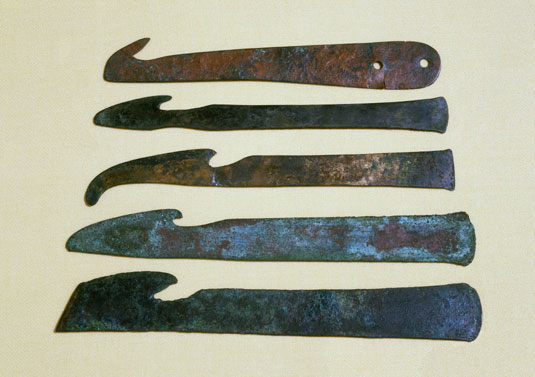
It is difficult to tell exactly when building began on the Cahokia site. This is because the people who lived in the area and built the mounds did not leave any written records behind. The only examples of their writing consisted of symbols that were found on copper, wood, stone and pottery. These have been found at the site and show that the area was lived in as well as used as a burial site. The city of Cahokia was settled around 600 CE and evolved into a sophisticated city with plazas, stockades and watchtowers. This was not surprising considering the fact that the city was a center for trade and, at one time, was the largest urban center north of the cities in Mexico. There may have been as many as 40,000 people living at Cahokia at the city’s peak.
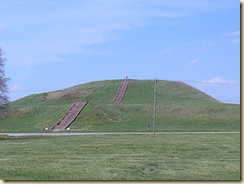 The main feature that dominates the area is Monk’s Mound. This mound is ten stories or ninety-two feet high. It is a massive nine hundred and fifty one feet in length and eight hundred and thirty six feet long. The mound took several centuries to complete. While it is massive, it is not the only interesting feature that can be found in the area.
One of the most interesting features is actually the Grand Plaza that stretches out from Monk’s Mound. The Grand Plaza seems to be where ceremonies were held by the residents who were living at the mound. Studies have shown that while the landscape was originally undulating, the residents were able to level and fill it in order to make a flat area where they could worship, celebrate and play games. It was one of four large, flat areas that radiate out from Monk’s Mound.
Another example of the site’s sophistication includes the Woodhenge. This was a circle of 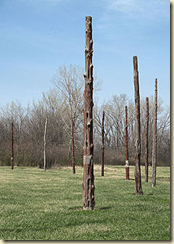 posts that was used in astronomy. It was made up of a series of posts which were placed so that they marked equinoxes and solstices. The wooden posts served much the same purpose as the stones that made up Stonehenge. Archaeologists were able to prove that not only was Woodhenge rebuilt several times during the past, remnants of another Woodhenge were also found near another one of the area’s burial mounds.
Although Cahokia was home to a sophisticated civilization, it eventually began to decline. This began in 1300 CE and the site was completely abandoned by the time the Europeans arrived in the area although some indigenous tribes did continue to live in the area. There have been many theories as to why the site was abandoned, ranging from disease to over hunting, deforestation and environmental issues that may have caused the area to become uninhabitable.
By: The Scribe on Wednesday, March 16, 2011
The role of women in ancient times varies from culture to culture. In some, they rode into battle beside the men. In others, they were expected to remain at home where they would bear their husbands children and keep the household in order. One culture where women were permitted and even encouraged to work outside the home was that of Ancient Egypt.
 In Ancient Egypt, there were several examples of women not only working as doctors, but, in some cases, overseeing the work of other physicians. The literary works that they authored on the topic of medicine were, in some cases, being read and studied hundreds, if not thousands of years later.
Of the female doctors who lived and worked in Ancient Egypt, perhaps the best known was Merit Ptah. She lived around 2700 BCE and was believed by many to be the first named female physician in history. She lived and practiced around the same time as Imhotep, who was well known as a healer, architect and builder of the Pyramid of Djoser. Although she was one of the best known female doctors, she was not the first woman to have practiced medicine in Ancient Egypt, and unlike another female doctor, her writings were not studied for thousands of years. She gave birth to a son who later became a High Priest and who gave her the title of “Chief Physician”.
Peseshet was a female physician who lived during the Fourth Dynasty (2613 BCE to 2494 BCE). Some historical records suggest that she may have been a physician and others that she may have been trained and employed as a midwife. Regardless of her training, she was given the title of “lady overseer of the female physicians”. This title is important because it shows that not only were a number of women working as doctors, but that they were also administrated and supervised by a woman as well. It was believed that she may have begun her medical training at a school for midwives that was located at Sais although it is unknown just how far her medical training progressed. 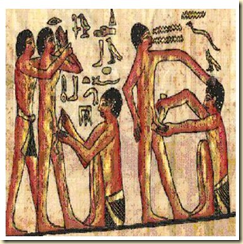
A third woman who was well known as a doctor in Ancient Egypt was Cleopatra (not to be confused with the former Queen and member of the Ptolemy dynasty). In Ancient Egypt, doctors tended to specialize in the treatment of certain diseases or parts of the body. Cleopatra was a doctor who worked in the twin fields of gynecology and obstetrics. In addition to working in the field, she also wrote extensively about her medical specialty and women’s health in general. Her works continued to be the focus of study for more than a thousand years.
Egyptian medicine was a unique mixture of magic and scientific fact. They were able to treat many diseases and injuries much more successfully than doctors could thousands of years later. They showed a need for cleanliness and a knowledge of anatomy and physiology that was very sophisticated for the time and yet, still believed in the need for divine blessings and magic charms.
By: The Scribe on Monday, March 14, 2011
Although many people tend to concentrate on the men in Roman politics, the women also had an important role to play in many cases. One example of this is Agrippina the Elder, who lived from 14 BCE to 33 CE. She was the granddaughter of Gaius Julius Caesar Augustus, who was emperor of Rome from 27 BCE to 14 CE. Her links to the Caesars of Rome did not end with Augustus, however.
 Agrippina was married to Germanicus, a general in the armies of the Roman Empire. She was also his maternal second cousin. She bore him nine children, although only six lived past childhood. Two of the best known would have to be her son Caligula, who later went on to rule the Empire, and her daughter, the Empress Agrippina the Younger. Many of her children still had important roles to play in the political life of Rome.
Her husband was a popular military leader and was adored by the common citizens in Rome. While Augustus was in power, everything looked good for Agrippina and her husband. She accompanied him on his military campaigns, which was something quite unusual for the time. It was far more normal for a Roman wife to stay at home with the children while her husband was off on campaign. This was something that earned her a reputation for being a very devoted and heroic wife. She also earned the reputation for being a skilled diplomat as well.
Because her husband was a favorite of Augustus, Germanicus was even considered by Augustus as the heir to the empire. If that had taken place, things would likely have turned out very differently for Agrippina. Unfortunately, her husband was passed over for the position and Tiberius was made Emperor instead of Germanicus.
Her husband died during a trip to the Middle East in 19 CE. Agrippina accused Gnaeus Calpurnius Piso, the man who was then governor of Syria, of poisoning her husband and returned to Italy with his ashes. She continued to be active in the political life of Rome and, over time, Tiberius began to suspect her of disloyalty to him. She was arrested, along with two of her sons, in 29 CE and was banished to the island of Pandataria, which is now known as Ventotene. There, she was flogged by a centurion and lost an eye in the process.
Agrippina eventually starved herself to death in 33 CE. Of her three sons, Drusus also died of starvation while imprisoned, and her son Nero died after his trial in 29 CE. Reports state that he was either murdered or that he committed suicide. Caligula, her remaining son, succeeded Tiberius as emperor of Rome. 
Although Tiberius tried to slander her name and reputation, he did not succeed. She was known for many positive things such as her courage and her devotion to her husband and her children. She also made it far more easy for women to wield power in Roman politics and showed them that women could indeed have a role in making policies that helped to shape the Roman Empire as a whole.
By: The Scribe on Friday, March 11, 2011
Romans often had a very busy religious life. There were many different religious festivals and rites that needed to be observed for well known Roman gods including Vesta, Jupiter and Juno but other than the religious ceremonies, these deities didn’t have much control over the daily lives of regular citizens. That was the responsibility of a collection of different spirits that were believed to reside in and around the home of Roman citizens. It was believed that these invisible spirits had a huge role to play in how harmonious, prosperous and peaceful a Roman home was and that if the spirits were not appeased, things could go very badly indeed.
If a Roman wanted to ensure that they would have enough food in the house, they didn’t go to Juno or Vesta. Instead, a Roman would pray to Panes or Penates. These were earth spirits who also held sway over the pantry and kitchen of a Roman home. They were represented by statuettes that were prayed to daily and which were set out on a table during a meal.
There were several different names for the spirits of dead ancestors. Ancestor worship was a huge part of Roman religious life. When someone’s mother or father died, it was believed that they became one of the Parentes, which were spirits of immediate family members. Parentes could also be the spirits of close relatives who were still living. They were represented by statuettes and it was not unusual for a Roman to take the statuettes of living relatives with them. The statuettes of living relatives were accompanied by fire from a Roman’s own hearth.
 The spirits of dead ancestors were believed to live in statuettes as well but these were known as Lares. A Roman family was expected to pray to them daily and make offerings to them at different times during the year. Significant dates such as anniversaries, weddings and birthdays were celebrated by more elaborate rituals.
Moving permanently from one household to another meant that the statuettes which represented the Lares and Panes would also be moved by the family. It was very important to Romans that the spirits were prayed to and worshipped properly. It was believed that if a spirit was not shown the proper respect or if a family forgot to pray to it, it could become wrathful or mischievous. Spirits who became unhappy were known as Lemures. Since the Romans believed that the world around them was full of spirits it was not unusual that they would think some were wrathful or out to do harm to the living.
Romans referred to the spirits of the deceased as Manes. The Manes were worshipped during a festival known as Parentalia. During the festival, sacrifices were made to the Manes. The sacrifices (which usually took the form of flower garlands, wine-soaked bread, wheat and salt) were placed at family tombs and the celebration was considered to be a positive one. However, the evil spirits were also addressed during Feralia, a celebration that marked the end of Parentalia. It was believed that unless Feralia took place, the spirits of the dead would rise from their graves and roam the streets.
Previous page | Next page
 The main feature that dominates the area is Monk’s Mound. This mound is ten stories or ninety-two feet high. It is a massive nine hundred and fifty one feet in length and eight hundred and thirty six feet long. The mound took several centuries to complete. While it is massive, it is not the only interesting feature that can be found in the area.
 posts that was used in astronomy. It was made up of a series of posts which were placed so that they marked equinoxes and solstices. The wooden posts served much the same purpose as the stones that made up Stonehenge. Archaeologists were able to prove that not only was Woodhenge rebuilt several times during the past, remnants of another Woodhenge were also found near another one of the area’s burial mounds.